With tantalizing news of dark-rumped petrels off Singapore, I managed to squeeze a boat trip into a somewhat hectic schedule.
As we headed out of Tanjung Dawai at 7am, the first birds seen at sea were not the most predictable ones - a Black-backed Kingfisher and a Yellow-rumped Flycatcher both flew over the bows and on toward land, skimming the surface of the sea. Both are known to be nocturnal migrants, so I guess these had just about reached the end of their flights, and were ready for some food and rest at the next headland! A fascinating glimpse of passerine migration!
There are twelve tern species on the Malaysian list. The only ones I've not seen from the boat over the last couple of years are Gull-billed, Caspian and Chinese Crested. The last is hardly likely off the west coast of West Malaysia, so eleven are realistically possible. I managed eight species today, and took over 500 photos! I'll only post a few for now, and maybe add others later. No petrels, or indeed anything else of interest bird-wise. The non-avian highlight was a mother and calf Bryde's Whale (thanks to Louisa for the id!).


Of the terns, I'll just include a run down of the species and plumages I recorded.

These are the three common species - Common (top left), Bridled (bottom left) and Black-naped (right).

Black-naped Tern juvenile/1st winter. Adult in breeding plumage.
 I assume this is an adult in non-breeding plumage. It differs from the breeding adult in having a dark smudge below the nuchal collar, a faint carpal bar, and grey subterminal spots on the outer primaries (except the outermost).
 A young juvenile Bridled Tern. The scapulars and mantle have dark brown subterminal spots and pale buff fringes.
 The crown is streaked brown and there is a gorget of brown streaks across the throat.
 A first winter (having undergone a head and body moult).
 I take this to be a worn 1st summer bird. It has moulted its head and body feathers into adult non-breeding-type plumage, but the wings are a combination of new feathers (eg inner primaries and inner primary coverts) and very old ones. Many greater coverts are missing, exposing the white bases of the secondaries below.
 Finally, an adult in pristine non-breeding plumage, having completed a full moult of both head and body, and wing and tail.
Moving on to Common Terns, which really are the commonest tern in these waters...

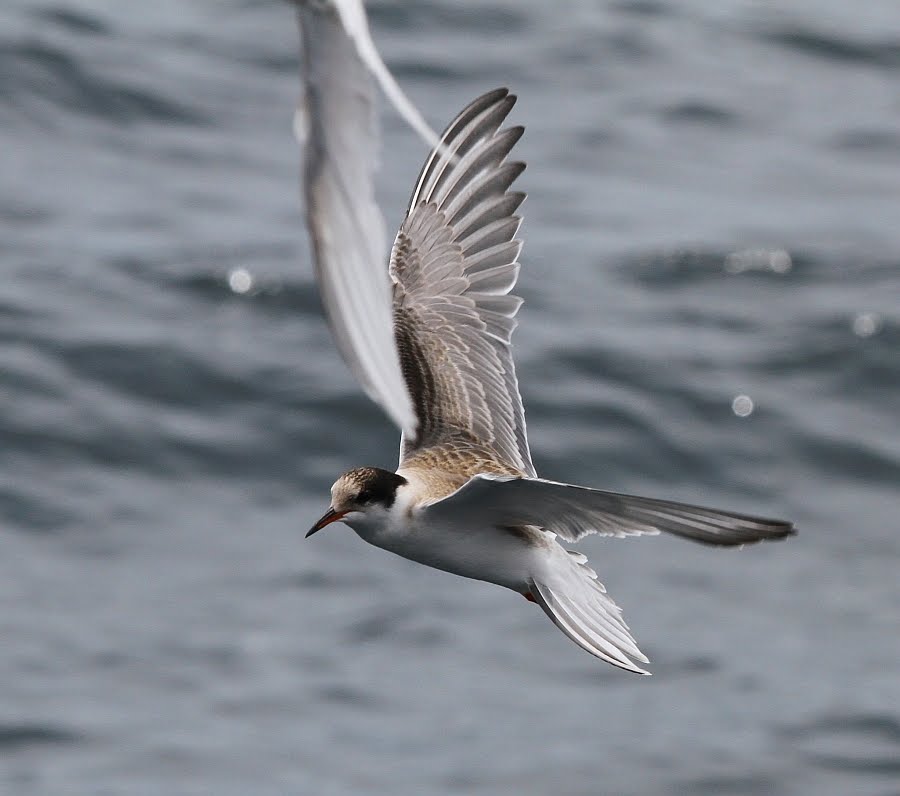
 A very young juvenile, which still has a brown forehead and brown mantle and scapulars. All ages of Common Tern show dark grey or blackish outer webs to the outermost tail feathers, which is a useful diagnostic feature.
 This one's a bit older, and has a white forehead and much greyer mantle and scapulars, the result of wear and moult.
 A fresh juvenile from below. Aleutian Tern would show much more clearly defined blackish secondaries.
 The largely grey mantle of this bird shows that it is progressing though its post-juvenile moult into 1st winter plumage.
 Some first winters can look quite pallid (but note the diagnostic outer tail feathers).
 This one showed a faint Black Tern-like mark on the sides of the neck.
 An adult in breeding plumage.

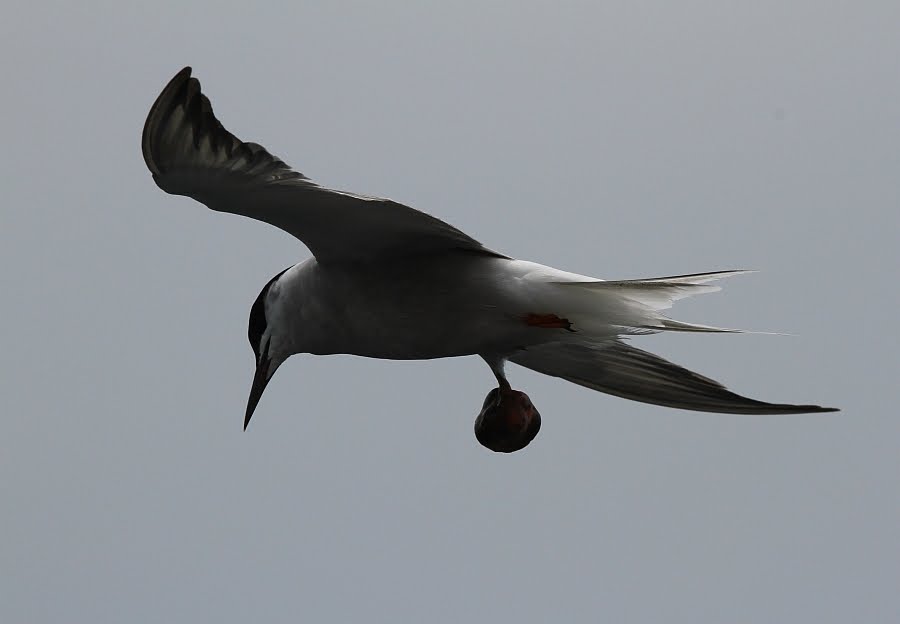
 This bird had a grotesquely deformity. The right leg had disappeared below the tarsal joint into a huge tumour.
 An adult in non-breeding plumage.
 Some more Common Terns.
 This Roseate Tern in adult non-breeding plumage was only the second I've seen off the west coast. Structurally, the wings are more centrally-positioned than on Common (so there's more head in front of the wings). Also, the bill is distinctively long. Plumage-wise, Roseates are paler than Common, with the outer three primaries distinctly darker. Note also the pure white outer tail feathers.
 An occasional Whiskered Tern joined the party.
 ...as did one or two White-winged Terns. These two species are a different genus from the others, and have noticeably shorter and broader wings and short compact bodies.
 This Great Crested Tern arrived late in the day and circled the boat a few times, calling. It was the eighth tern species of the day.
 Near dusk this 1st winter Common Tern landed on the boat and began gorging itself on anchovies in the net. It appeared relatively unbothered by human presence, allowing approach down to a few feet.
 My presence probably saved it from meeting the same fate as incautious shearwaters!
 A glorious sunset...
 And the end of a long day!


+Rufous-backed+Kingfisher_Sepilok+NR_141010_IMG_7793.jpg)