Friday, June 01, 2012

26-30 May: Cameron Highlands

The idea was a few days of peaceful family holiday; the reality was that this was school holidays, when peace and Cameron Highlands are not words easily associated with one another!

A few photos from the four days away.


A couple of shots of not-so-easy-to-see Bay Woodpeckers - these were very vocal at the summit of Brinchang at dawn.


Snowy-browed Flycatchers are typical denizens of the shady mossy upper montane forest. They're completely fearless, and often the first indication of their presence is an awareness of a pair of beetling white eyebrows glowering at you from the side of the road as you walk past!
Lesser Shortwings are very common at the summit too, and come out onto the road to feed at first light.
I set up my hide at the roadside one day, and soon realized I was in the vale of the dinosaurs! First I found myself eyeball to eyeball with this juvenile Robinson's Anglehead Lizard.
 Quite a fearsome-looking beast!
 Then the Daddy dino turned up. Check out those teeth - enough to give a nasty nip!
This third one was missing the end of its tail - a subadult male I think. They all foraged a few feet in front of my hide quite amiably.
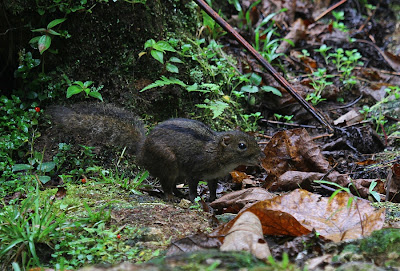
I also discovered I had parked myself near the home of a Three-striped Ground Squirrel. It provided me with regular entertainment as it darted in and out of the undergrowth collecting stuff.
 
 
Avian visitors were limited to a male Large Niltava (briefly) and a female White-tailed Robin (regularly).
Another day was spent in the hide at my favourite cuckoo-dove watering hole. Here are both species - Little on the left, a male Barred on the right.
A male Little.
And a female I think.

Male (top) and female Barred Cuckoo-doves. This is one of my favourite pigeon species - dunno why - perhaps it's because it took me so many years to see my first!
The female back-on.
Males of both species appear much larger than females, and are much bigger around the head and neck - perhaps the better to coo with!
 A female (front) and male.
The green gloss against the greys and browns of the rest of the plumage is one of the best colour combinations  I've seen in nature.


Later I moved my hide down to the stream to try to photograph the doves coming down. I wasn't successful - they were too wary I think - but I was rewarded by this juv Slaty-backed Forktail and male White-tailed Robin.

Wednesday, May 30, 2012

22-26 May 2012: Krau, Pahang

Krau Biodiversity Centre, set in Krau Game Reserve, isn't a bad place to be if you have to attend a training course! Even though the course kept us busy for most of the daylight hours, I still managed to squeeze a couple of hours in here and there at the beginning and ending of each day.

Early morning walks were productive for frogmouths, with this confiding Gould's perched about 5 feet off the ground...
And a splendid pair of Large Frogmouths put on a fantastic show. This was the brighter-plumaged and more aggressive of the pair, so I assumed he was the male. This rear view shows faint "ear tufts" and a prominent nape line.
 This is him reacting strongly when I played his call back.

The second bird was greyer and much less strongly marked. I judged this to be the female of the pair.
A comparison with the other bird.

In BirdingASIA 14, Tan Gim Cheong and Yong Ding Li mention the following plumage differences in a breeding pair:
1. The well-marked bird (presumed male) showed white traingular marks on the wing coverts with little or no black edging. The other (duller) bird showed more tear-drop shaped covert spots, edged with more black.
2. The scapulars were tipped black on the duller bird, but had black subterminal spots and buff tips on the brighter bird
3. The brighter bird had more well-defined pale buff brows than the other.

All three of these differences can be discerned in the two photos above, suggesting that these may be consistent plumage differences between the sexes.

Apart from the typical growling calls, both birds gave chicken-like clucks, which appeared to be alarm or threat calls uttered in response to my playback.

Also out and about early were swiftlets which were clearly different from the familiar pale-rumped Germain's which I see regularly at sea and around swiftlet farms. I assume that these were Black-nest Swiftlets. 

These birds were greyer overall (notwithstanding the lack of light), with barely notched tails. The wings appeared to be set slightly further forward on the body, with a longer tail projection (very thin when in profile) and a shorter head projection than on Germain's. The head was noticeably larger than Germain's - an impression in the field borne out by comparison of photos:
 
Black-nest Swiftlet. Note the neckless appearance and large domed head profile.
Germain's Swiftlet seen off Tanjung Dawai on 10th May. The wings seem more central, there seems to be more neck, and the head is small, typically with a flat head profile.

A few more birds of note - a blue morph Rufous-winged Philentoma.
  
An Olive-winged Bulbul.
 
And an overflying Large Green-pigeon at dusk.

I enjoyed a few days catching up with my old birding friend Mike Chong. On the morning after the course, we spent a fruitful morning birding along the road. After an hour's separation, I returned to find that Mike had been watching a family party of Grey-and-buff Woodpeckers over his head for five minutes! In case you don't know, G and B W is (and remains) my No. 1 bogey bird in Malaysia!

Friday, May 18, 2012

Coming soon to a garden near YOU!


Don't forget - June 2-3 are the dates!

Thursday, May 17, 2012

16th May 2012: Pelagic off Port Dickson, Negri Sembilan

Having sent out the challenge for people to get out on the water at the southern end of the Straits of Melaka to look for Swinhoe's Storm-petrel and Aleutian Tern last week, the opportunity arose for me to go and test my own theory this week, courtesy of John Howes organizing the very first pelagic charter out from Port Dickson on Wednesday.

The pioneering team consisted of John, myself, Rafi, Swee Seng and Carol, and Merijn, and John was anxious to set expectation low to minimize any potential disappointments! It was impossible not to feel a slight twinge of eager anticipation as we set out however, not to say trepidation, once we saw the size of the boat!

Big boat, small boat! We were heading out into the most congested shipping lanes in the world in a 30-footer - but hey - that's what pioneers do...isn't it??
The bow-wave alone of this behemoth was about 4 times the height of our boat. We actually got the full horn treatment just before taking this picture - I guess it was easier for us to move out of the way than for him!

There goes a forest. Mind-boggling to imagine the number of trees which are on this ship alone. But did you notice that little bird skimming the waves this side of the ship? A case of a lot of fuel and a little petrel (groan)!
I can't remember how many times I've watched Germain's Swiftlets skimming across the waves at sea and wished they were Swinhoe's Storm-petrels. At last, this was the real thing, looking surprisingly like Germain's Swiftlets!

Fortunately, the birds pitched down on the sea and we were able to approach them slowly. Being very near the water surface ourselves, it was difficult to get a clear view of the birds as they frequently dipped out of sight beneath the wave-tops. Getting the birds in focus was another challenge, as both we and they were moving up and down asynchronously!


 Not a sharp shot, but it gives a clear view of the tail shape.
The birds were in pristine plumage, with nice clear upper wing covert bars and white flashes at the primary bases. Their flight style was languid, keeping very low (following the wave troughs) and banking from side to side as they went. Sadly, this time they kept going, and we didn't see any more. Still, I was more than chuffed. Mission accomplished!
Being in such a small boat, spray was a real problem, so I mostly kept my camera well under wraps. I did risk taking a few shots of this first year Arctic Skua as it flew over, and a few were sharp. Compared to the Tanjung Dawai boat, this one was much less stable, making photography much more of a challenge. 

Other than these, we saw a single 1st year Long-tailed Skua, a Short-tailed Shearwater and 121 Bridled Terns. Though relatively modest totals, they more than met expectations, with everyone on the boat getting at least one 'lifer' (and one got an absurd FIVE new birds in just half a day!).

 It did get hot though!
 A couple of pirates? Oh no - Seng and Carol doing a good impression!
 
Cape Rachado, Tanjung Tuan lighthouse from the sea. This is where we do the Raptor Watch from every March. The gap between Sumatra and Malaysia which the OHBs fly across looks very much wider from sea level!

This wasn't at sea! I spent the night at Rafi's place, and was rewarded by great views of a female Little Green-pigeon in his back garden this morning! Thanks Rafi, and thanks to the PD Pioneers, including Raja, our enthusiastic and sharp-eyed boatman (he got us several birds), especially John for organizing everything. 

PD Pelagics have great potential I think, especially if we can get a bigger, higher boat. That, and a chum bucket in September should be quite something I would think.

Oh - and congrats to John on reaching 550 for Peninsular Malaysia with the addition of Arctic Skua and Short-tailed Shearwater!