Showing posts with label butterfly. Show all posts

Friday, June 22, 2012

20 June 2012: Lata Bukit Hijau, Kedah

With Grey-and-Buff Woodpecker having finally fallen, I have been badly in need of a new bogey bird to give me something to complain about! Well, the search is over and I can proudly announce that my new bird-I-should-have-seen-by-now-but-haven't is...

White-tailed Flycatcher

Although not in the same league as the woodie (which drew astonished gasps from even novice birders when I let slip that I hadn't yet seen one) - the flycatcher is a genuinely difficult bird to see in Peninsular Malaysia -  it does have the essential 'bogey bird qualification' of having been repeatedly searched for and not seen. I've searched for it at the Gap and Ulu Gombak, and more recently Penang Hill, where rumours of a pair tempted me to scale a fiendish set of steps in the forlorn hope of seeing them.

My latest failure was today, when I set off pre-dawn to Lata Bukit Hijau, Kedah - a once-scenic series of waterfalls cascading through some secondary forest.


Leptospirosis anyone? Another ecotourism success!

Sadly, no sight or sound of the aforementioned flycatcher, or indeed, almost any other birds - just two male Rufous-winged Philentomas chasing each other round the forest.
The highlight of the morning was this gathering of butterflies on a pile of ... er, poop. I love the little guy with the red wings and funky blue topknot - if anyone knows what it is, please do tell! [This helpful reply is from Tou Jing Yi:

"The large ones should be Amathusia phidippus (Palm King).

The lovely small ones are some skippers, but being so colorful, should belong to the subfamily that are collectively known as "Awls", this particular one I believed is the Burara etelka
(Great Orange Awlet), I should have seen these once....

The yellow ones are actually moths, but being colorful and day flying, could easily be confused as butterflies, a few similar species occurs together, this one should be Dysphania subrepleta, hard to be certain from this angle but the wings seemed to be reasonably well marked, at least 2 other similar species occurs in the same habitat." Thanks, Tou!

Thursday, July 07, 2011

29 June - 4 July 2011: Poring, Sabah

Just back from a relaxing few days in Sabah, initially to do a survey of bird life around a new Jungle Camp, entrancingly called "Lupa Masa" (Forget Time), and then to spend a few days in the more familiar Poring Hot Springs park area.


The dining area. The place really blends in with its surroundings, and it is not difficult to indeed forget time there. The story of the genesis of this place can be read here. It's not long before the only clock you take notice of is the natural rhythm of the dawn-day-dusk-night.


You sleep in 'sulaps' - ingenious structures housing cozy hammocks complete with mosquito nets. From one of these some lucky visitors had wonderful views of a Yellow-throated Marten family at play.


I wasn't quite as lucky, but was fortunate enough to photograph this male Purple-naped Sunbird while laying on my sleeping-bag!


It was only a few metres away, yet completely oblivious to my presence! Very nice!


Not a bad place to cool off after a hot day in the jungle! Complete with fish which nibble your toes, and the occasional Bornean Forktails and Bornean Whistling-thrush.


The endemic Yellow-rumped Flowerpecker was a common visitor to the dining room verandah.


Black-winged Flycatcher-shrikes were also seen there daily.


If you visit the camp, look out for this fellow - I think he's wanted for rustling!


Lupa Masa offers some exciting possibilities for exploring the quieter areas behind the national park. I spent the last few days of my stay in the park proper, trekking up to the spectacular Langanan Waterfall.

You can't go to a place called "Poring' and expect not to get wet, it is RAINforest after all! The rain was fairly predictable, however, usually arriving around midday or early afternoon, giving me clear mornings.


On my first day I decided to reacquaint myself with one of the Park's more well-known residents - Blue-banded Pitta.


This was a markedly brighter bird than the one I photographed at Kubah in Sarawak - too bad I didn't quite get the same photographic opportunities!


The red on this bird is far more intense and 'pure' than on the Kubah bird, and the blue chest-band is broader (cf these pics and these.

I spent a lot of time on the trails hoping for a shot of Bornean Banded Pitta, but a single call was the closest I got for my efforts!


I was pleased to get a look at the Bornean melanops race of Banded Kingfisher. This one was wrestling with a large stick insect. As I watched, it flew to another branch where a juvenile was waiting quietly.


Too bad my camera's autofocus popped out at the critical moment, but I was interested to see that the fledglings are sexually dimorphic - this one is clearly a male.


A bit late now, but a sharp shot at last!


Another juv Banded,another endemic subspecies (brookei), but a Broadbill rather than a kingfisher - rather overflashed! This and Black-and-Yellow were my only broadbills of the trip. Despite much searching, the Hose's remained elusive.


A few non-avian images. The second butterly was huge, and in flight had exactly the colour scheme of a White-crowned Shama (and it was nearly as big!).


Some friendly frogs!


A Plain Pygmy-squirrel...


...which was not only cute...


...but also fascinating! As it moved around it constantly rotated the rear of its body to rub itself against the bark of the vine - whether to scent-mark, alleviate some itch, or for another reason I couldn't tell.


OK, so sometimes I was bored!


This Grey-headed Canary-Flycatcher seemed to be permanently stationed on this particular dead branch at all times of day and every day. This enabled me to try out every possible variation of ISO, flash setting and shutter speed, and still only come up with a rather mediocre series of photos! I'm hoping one day someone will help me understand how to use flash properly!

I'll finish off with two hard-to-photograph species:


Olive-backed Woodpecker (juv?) male.


Female.


And a rather fine White-necked Babbler.

Wednesday, April 07, 2010

30th March 2010: Lower Kinabatangan, Gomantong Caves and Sepilok

Our last morning at KJC was spent on another excursion to look for the ground-cuckoo.


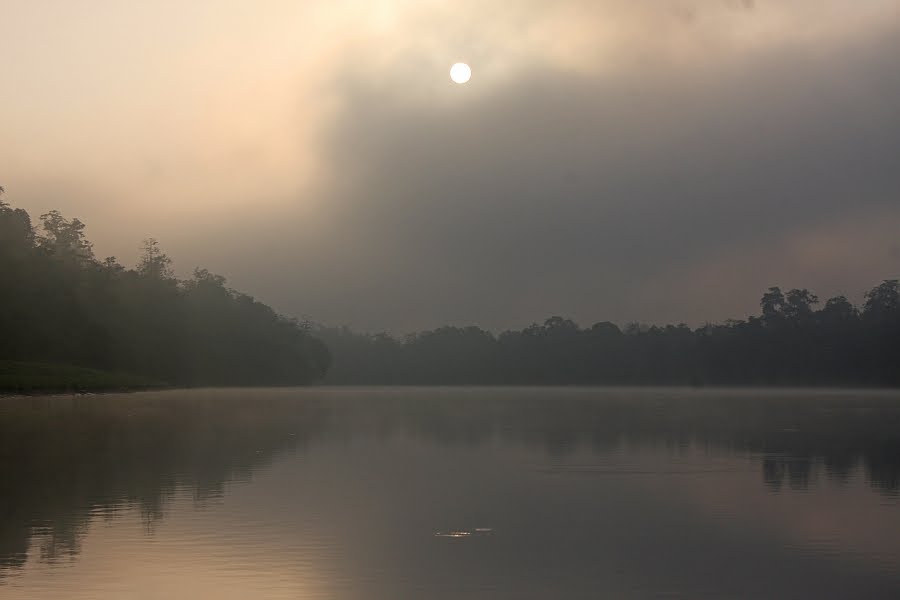
The river just after sunrise.


One of our first birds was this Storm's Stork feeding rather close to the water's edge.


It flew up into a nearby tree at our approach, so we probably saved it from being a croc's breakfast!


Have a guess what this is!


Taking a morning bath at speed!


Did you guess right? A pair of Brown-backed Needletails came down to bathe near our boat. This stunning performance was one of the highlights of my whole trip. Sadly neither the camera nor the photographer were quite up to doing the whole experience justice!


Turning up the creek to look for ground-cuckoos, I finally got a shot of an Oriental Pied Hornbill in good light. This is a male.


Wood Nymph butterflies have a unique slow fluttering wing action. This one went right over us!


Black-naped Monarchs are commonly heard, but less easy to see well. This male had just had a dip in the river and was finishing off his morning ablutions.


We came to a log that had fallen across the creek, effectively turning it into a cul de sac. This Oriental Darter found itself caught between us and the fallen tree, and wasn't quite sure what to do, enabling us to get great views of it.


The tertials and tail feathers are quite extraordinary. They look as if they're made from PVC rather than feathers!


Eventually the bird had to move, so it opted to fly as far as the fallen log.


It then sank out of sight like a submarine diving, only to appear from the neck up near the bank, trying to look inconspicuous.


Finally, it decided to make a dash for freedom, so with much flapping and splashing, it took off and flew past us. Fantastic!


Meanwhile on the fallen tree itself, a troop of Pig-tailed Macaques were sunning themselves. These youngsters were busily quarrelling, quite oblivious to us.


They made friends again later!


I started to feel guilty under this one's reproving stare!


I decided this one must be a teenager!


On our way back we came across this female Rufous-tailed Shama carrying food. Robert told us that this is a rare bird here - more rarely seen than the ground-cuckoo in fact...! This was not much consolation for the continuing silence from the cuckoos.

We had brief views of Scarlet-rumped Trogon and a Hooded Pitta, but otherwise, the birds were much the same as yesterday, until...


...Robert pointed out a couple of White-fronted Falconets - two males. My first lifer since arriving in Sabah!


Fairly high up, but that's quite typical of falconets I guess!

Oh well, plenty to come back for, which I certainly plan to. The Lower Kinabatangan is one amazing place!

En route back to Sepilok, we stopped to look at a few birds...


...a Striated Grassbird


...and several Bat Hawks. Bat Hawks were about the most frequently encountered raptor on my trip. I counted 7 birds between Kinabatangan and Sepilok. Every mengaris (tualang) tree seemed to have at least one bird, even if the tree was the only one standing in a sea of oil palm.


We stopped off at Gomantong Caves so that we could tick off Edible-nest, Black-nest and Mossy-nest Swiftlets (pic), which can all be safely identified as they sit on their distinctive nests. The rain made the steps in the cave treacherously slippery, and the handrails were not much help, being covered in guano and crawling with cockroaches. The stench of ammonia from the guano in the cave was pretty powerful.

Also en route back to Sepilok, we stopped and scanned a weedy pool in an oil palm estate. It only had five Common Moorhens and a Little Grebe on it, so we didn't spend much time there. It was only when we reached Sepilok and I checked Myers that I realized that there are only a small handful of records of Little Grebe from the whole of Borneo, and that it was undoubtedly the rarest bird of the trip!


Back at Sepilok just before dusk, we made for the Bristlehead Tower again. I got another chance to photograph the male Scarlet-backed Flowerpecker, and another chance to miss Bristlehead! The flying squirrels weren't in the mood tonight either - only a couple appeared long after dark.


After dinner we went out to try for night mammals and birds. Our success was limited - a few Brown Hawk-owls, this Colugo...


...and a roosting Black-backed Kingfisher, looking like a gem in the spotlight!

So, four mornings and four evenings at Sepilok produced no Bristleheads, three days at KJC produced no ground-cuckoos, and in the whole trip I only saw one new bird! Nevertheless I was well-pleased with this trip, and it gives me a good excuse to go back again!