Since I was up early to watch the Holland vs Uruguay semi-final, I thought I might as well make good use of the early start by going back to Air Itam Dalam before dawn in the hope of seeing the Great Eared-nightjars again.
From where I had seen them two evenings ago I was able to pinpoint more or less where they would be roosting, and managed to get good views of several birds in courtship flight and calling. Unfortunately it was way too dark for photography.
 I did manage a distant shot of a bird sitting on the topmost frond of a palm which it was using as a song-perch. I was quite surprised how prominent the 'ears' were. Pre-dawn was quite lively, with Barn, Spotted Wood, Collared Scops and Brown Hawk-owl all calling.
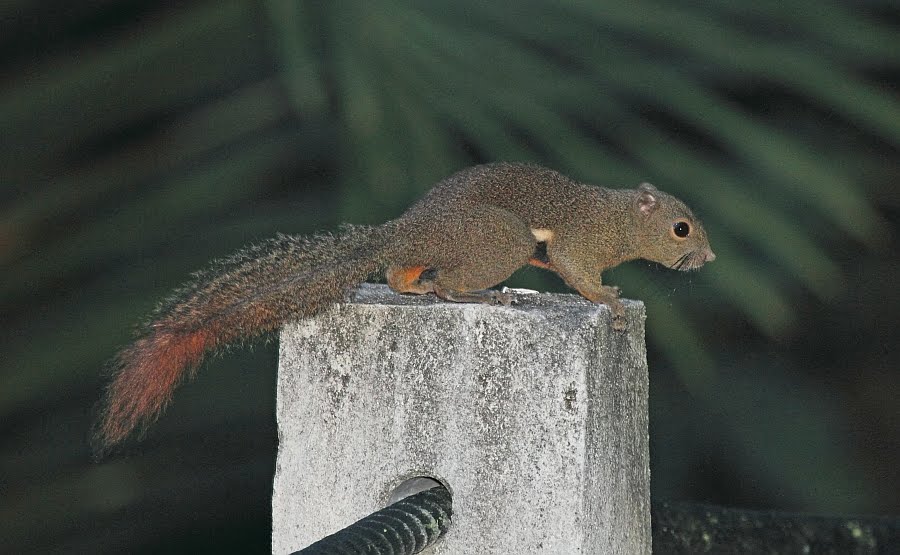
 This Plantain Squirrel was running along the boardwalk handrail in the early morning.
I was still hankering for returning migrant waders, so decided to move on to Pulau Burung landfill site to see if any had arrived yet.
 The future of our wetlands unless we learn to do with less? I was shocked to see that this area, which had been open water on my last visit, is now full to the brim with trash!
 Even more shocking was the fact that a pair of Black-winged Stilts were evidently holding territory on this stinking mass. It's easy to blame the landfill authorities for this sad situation, but it's not that simple. That waste the birds are forced to live among comes from my home and yours (well, not ALL of it, but you know what I mean!). It's a sobering thing to see where our 'throw-away society' ends up.
 That attractive pink colouration on the underparts is probably some kind of chemical staining.
 Along with the stilts were a couple of Wood Sandpipers and a lone Curlew Sandpiper - migratory species but probably not recent arrivals - it's highly likely that these non-breeders never went north last spring.
 A colony of Oriental Pratincoles still uses the place. A few adults were carrying food, indicating the presence of dependent young. Not sure what the prey was here.
 Most birds I saw were fully-fledged juveniles from an earlier batch.
 I was quite pleased how well these turned out given the poor lighting conditions.
 This is always a reliable site for roosting Savanna Nightjars. Getting a clear view of them is another matter as they hug the contours and quickly disappear over the next ridge when flushed!
 Lesser Whistling-ducks are thriving at this site, with about 50 birds now in residence. Further population expansion was certainly on the minds of some of the males!

 Lots of avian testosterone flying around here!
 The books say the sexes are similar, but I wondered whether this bird, with the weakly marked flanks and crown, might be a female...
 ..and this one, with a darker crown and more distinct pale flank plumes, might be a male.
 July is a prime month for a rare Austral visitor to the Peninsula, Horsfield's Bronze-cuckoo. There have been about ten records in Singapore, but only one so far in West Malaysia. They seem to favour mangroves and coastal areas, so I spent quite a bit of time scouring the mangroves along the coastal bund. No luck with the cuckoo, but it wasn't entirely a waste of time!
 I found this motorbike parked along the bund, no doubt by a fisherman, much to the delight of the local troupe of Long-tailed Macaques, who just couldn't resist 'dropping in' for a closer look!
 Eat your heart out, Evil Knievel! Here, we call street-racers 'Mat Rempit', but they ain't got nothing on these stunt-riders!
 "Look ma, no feet!"
 But the coolest things were the mirrors!
 "Hey, come and check this out - there's one ugly monkey in this picture!"
 "Guess what? He's over here as well!"
 "I don't know - he looks pretty good-looking to me!"
 "He likes me! He's smiling!"
 Ouch! I only realized what they'd been doing to the seat of the bike when I drove off. The fisherman won't be too happy!
 I found a small group of flamebacks, including this female Common.

 ...and this interesting male. The malar pattern is pretty unusual for Common Flameback, looking more reminiscent of Himalayan Flameback, which occurs as far south as southern Myanmar. I'm sure this is just an odd Common - they're probably more variable than we give them credit for! Anyone got any thoughts?
 A male Greater Flameback was in the same party of birds!
Can anyone help me identify this Draco sp flying lizard? It was in the mangroves. [Thanks to Muin for responding to this request. It's Draco sumatranus - Common Gliding Lizard.] Just inland of the mangroves, in some scrub in oil palm, there was a Blue-winged Pitta calling. They seem to be on the increase in this part of the country.
 One was standing sentinel on the access road and wasn't that interested in giving way to my vehicle!


 I could only see two juveniles - suggesting that the season hasn't been a good one. Both were just fledged. Sometimes pratincoles will raise a second brood after the first is fledged - wonder if this may happen here?