Friday, February 16, 2007

13th and 14th Feb, Tanjung Tokong

I spent a couple of not very romantic evenings up my middle in mud, helping a team of scientists from the local university to trap shorebirds at my local patch!

We set up mist nets at dusk to trap birds as they flew to roost at high tide. It was fun but very exhausting!

We managed to catch 6 Redshanks, a Common Sandpiper, a Curlew Sandpiper, a Broad-billed Sandpiper, a Terek Sandpiper, one Lesser and one Greater Sansplover, and 3 Little Herons. We also caught around 20 Dog-faced Fruit Bats and 1 Cave Nectar Bat - sharp-toothed little beasts!


Checking out the mudflats with the evening sun behind us.


A couple of shots of a flock of Red-necked Stints flying in perfectly co-ordinated formation.


Setting the nets before dusk


The mudflats by night - lots of ambient light, so not ideal for trapping birds.


Lesser Sand Plover in wing moult.The inner six primaries are fresh and full grown. 7 and 8 are still growing, and the outer two, 9 and 10, are old unmoulted feathers.


Measuring the bill length, from the base of the culmen to the tip.


Measuring the head and bill length, from the rear of the skull to the tip of the bill.


Measuring the nalospi, the distance between the tip of the bill and the distal edge of the nostril.


Measuring the tarsus.


Measuring the middle toe.


A good comparison of the bill shapes of Greater (above) and Lesser Sand Plover. Note that the 'nail' (bulge on the culmen) starts about two-thirds of the way along the bill of Lesser, but about half-way along in Greater. The tip of the Greater's bill is also noticeably sharper and less blunt than that of Lesser.


Another shot of the Greater Sand Plover, showing the olive-yellow leg colour, which tends to be a good distinguishing feature of this species.


A Broad-billed Sandpiper showing off its broad bill!


Terek Sandpiper. Note the deformed toes on the left leg.

Tuesday, February 06, 2007

More pics and views on yesterday's martin

Having convinced myself that yesterday's bird was probably just a Sand Martin, based on the apparently warm colouration, I received the following reply to my request for help from Paul Leader in Hong Kong (reproduced here with permission):

"These are Pale Martins. Structurally Sand Martin can be easily eliminated by the very short shallowly forked tail. On Pale Martin the tail when slightly spread is square, on Sand Martin there is still an obvious fork. In one photo at least I can see five tail feathers on either side of the central pair, so there is no tail moult.

In the field the breast band on fokhiensis (the 'Pale' Martin with which I have most experience)often appears darker than is illustrated in field guides or I would expect from skins. The lack of a marked breast also eliminates Sand Martin, note also how narrow the breast band in on one of your birds.

The structure at rest is diagnostic as you state [the wings extend beyond the tip of the tail]. But do not get too tied up in overall colouration, note in your birds the marked difference in colour in the freshly moulted primaries and the old ones. I have found light conditions also have a strong influence on perceived plumage
tones in Pale Martins.

I would have assumed that these were fokhiensis, however these have obviously dark underwing coverts which fokhiensis lacks and in fact fits better ijimae Sand Martin. I can think of two explanations for this:

1) fokhiensis has dark underwing coverts when they are freshly moulted and
2) these are not fokhiensis but another taxon from the diluta complex e.g.
thibetana.

2) seems more likely."

Paul has also identified this martin I saw in December as Pale Martin, with the following comment:

"I think very little attention has been paid the Pale/Sand Martin issue in SE Asia. In HK for example, it appears as though Pale Martin is much more common, with the exception perhaps, of late spring."

Here are some more pictures of yesterday's bird:


Monday, February 05, 2007

Monday, Feb 5th, Penaga ricefields

This post is mainly about one bird - a martin that I spent about one and a half hours watching and trying to photograph this morning. The bird was hawking insects over some uncut padi with a few hundred Red-rumped and Barn Swallows.


The bird was obviously Sand Martin-like, quite warm-brown above (in morning sunlight), but several features made me wonder if it could be a Pale Martin. I am 90% sure only one bird was present, though some of my photos do make me wonder if there were actually two.


According to Robson's Birds of South-east Asia, Pale Martin can be distinguished from Sand Martin as follows: "slightly smaller and smaller-billed with slightly shallower tail fork, upperparts slightly paler and greyer, underparts less clean white, with creamy wash on belly and undertail coverts, breast band paler but neater, lacks dark smudging on centre of breast/upper belly."

Photos on the web show that Pale Martins can show some central breast smudging, especially the race fohkiensis (see here)


What initially drew my attention to the bird was the apparent absence of a central breast smudge. This was not visible at all through binoculars, though is apparent on some photos as a faint greyish wash. The tail looked quite squarish, though it was evident that the bird was in some stage of moult.


The vent and undertail coverts seem to be creamy or buffish on this photo.


I don't have enough recent experience of Sand Martins, nor any of Pale Martin to be able to make a certain identification of this bird. Hopefully, there are others who do who can help out!

Several hours later: Well, I've learned a lot about Pale Martins in a short time! It seems that the best way to separate them from Sand Martins is, when perched, their wings extend well beyond the tail tip. Other than that, they are markedly grey-brown, which my bird clearly was not, so on that basis, it was a Sand Martin! For pics of what a Pale Martin looks like, see here

Sunday, February 04, 2007

Pinang to Kota Baru, 1st - 2nd Feb, 2007

Took a very quick trip to Kota Baru, capital city of Kelantan, last week on a business trip, but managed to squeeze a few birds in en route!

First off was the Bat Hawk tree. The pair has been in residence for at least 5 years, according to a local man we spoke to. They have recently begun incubating their second clutch of eggs in the last six months; they raised a single juvenile late last year.

When we arrived in the late afternoon, the wingtip of one bird was just visible in the nest, while the other bird roosted quietly in the same tree.

Also nearby were a flock of Fork-tailed Swifts of the race cooki or kanoi, with their barely visible white rump patch.

A quick snack break at the Banding Island Resort provided distant views of this Grey-breasted Spiderhunter.

One more stop was to watch the sun set over Tasik Pergau, one of the lesser known lakes in the north of the Peninsula.

We stayed at a resort called Pasir Belanda, just outside the city, and it's a place we'd recommend highly! Full details can be found here.

We stayed in a beautifully-crafted chalet built in traditional style, and enjoyed our breakfast overlooking the river in amazingly cool and breezy surroundings.


A view of our chalet by night.


Having breakfast overlooking the river.


The river was rapidly being clogged by invasive water hyacinth, but it proved attractive for waterbirds, and we saw Yellow and Cinnamon Bitterns and Slaty-breasted Rails as we ate breakfast, as well as commoner waterbirds.


This water buffalo seemed to have put its horns on the wrong way round (and you might want to count its legs)!


This Green-billed Malkoha was another interruption to our late breakfast.


A view upriver...


...And across to the far bank. We weren't sure what animal this tree was trying to be - a rabbit, or a giraffe with an Elvis quiff were two suggestions!


This Clouded or Bengal Monitor (Varanus bengalensis) was a nice alternative to the commoner Water Monitor. It can be distinguished by the crescent-shaped nostril about midway between the snout and the eye.


Flocks of White-rumped Munias constantly patrolled the patches of long grass in the river.


I tried to take a picture of a Collared Kingfisher in a frangipani tree at dawn. The flash didn't fire, but I still quite like the result! (you may need to click on the picture to enlarge it if it's too dark on your screen).


And here's a frangipani flower taken at the same time.


On our way home we stopped to take a picture of this amazing advertisement, with slogan: "Avoid tiger attacks! - make sure that your orchard is always clear of undergrowth."


A view north into Thailand from the top of the Titiwangsa Range.


We reached the Bat Hawks at about 5.30pm. At just before 6, the bird on guard duty began calling the to incubating bird.


The incubating bird flew from the nest and joined its mate.


The first bird then flew off and out of sight for about 5 minutes...


...before returning to the nest carrying a small stick.


It then settled down to take its turn incubating the eggs. The bird which had just come off the eggs settled down to snooze, and had not moved by the time we left at 6.45pm.


A flock of swifts descended above us as dusk fell. More pictures of 'cooki' or 'kanoi' race Fork-tailed Swifts.

Thursday, January 25, 2007

Monday 22nd January, 2007, Tanjung Tokong

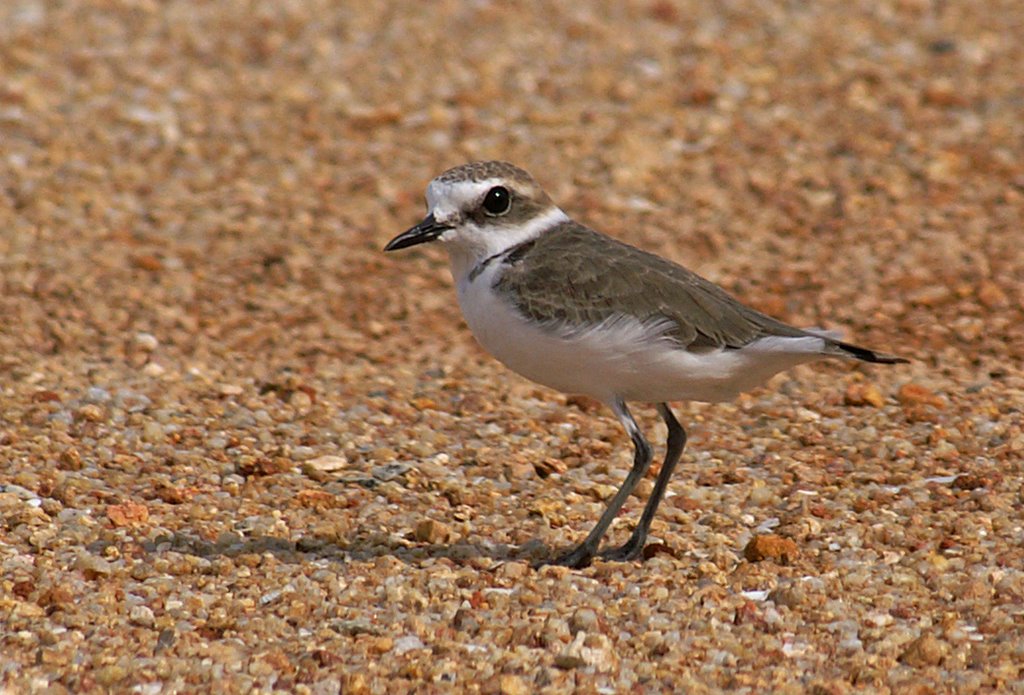
In a last attempt to get pictures of the mystery plovers I set up a hide on the mudflats in the morning and then lay in it for three sweltering hours as the tide rose. The result - Kentish Plover 22, mystery plover 0! I think I have to face the probability that I won't see these birds again till next November at the earliest, and who knows what the site will offer to shorebirds then?


A male Kentish sitting on his personal roosting spot!


Man, but it was hot out there! This female Kentish pants to cool off


Eventually the birds roosted on the construction site. Here's a male coming into breeding dress.


And a female - what BIG eyes you've got!


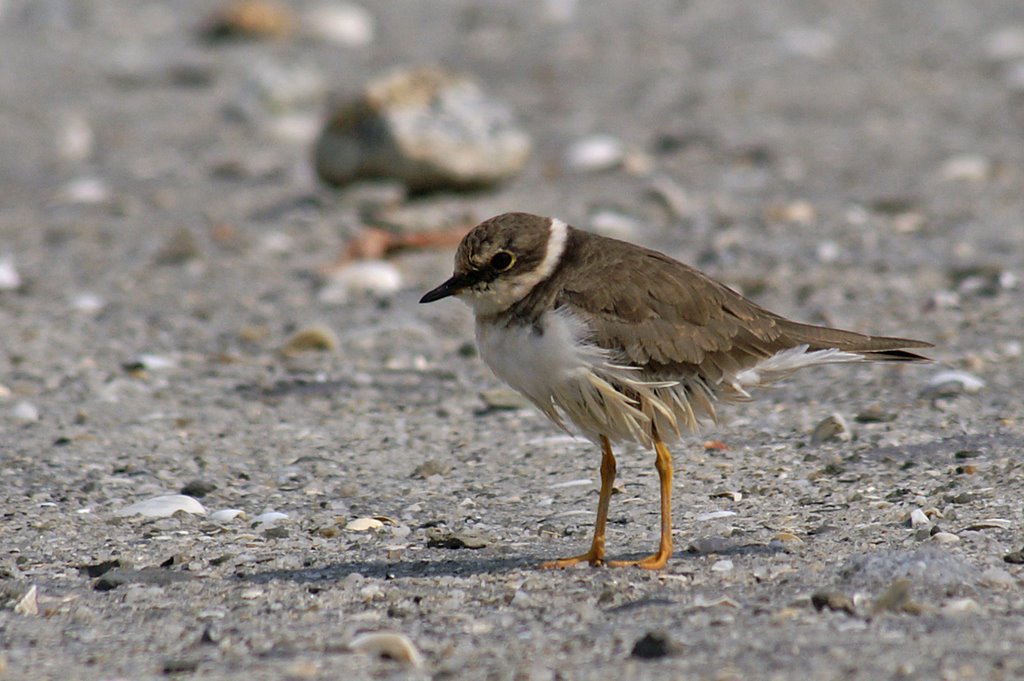
The foreshore is covered in rubbish and chemical pollution. Sadly, this Little Ringed Plover has picked up some of the gunk on its belly feathers, and the likely outcome will be fairly swift death, either through ingesting the stuff in an attempt to clean itself, or through loss of body heat due to the feather damage.


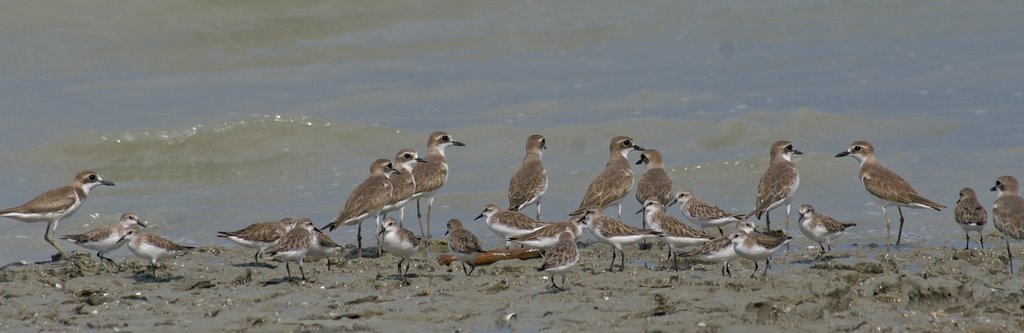
It was nice to see Greater Sand Plovers outnumbering Lessers for a change today - it's not often that happens. There's just one Lesser Sand in this picture - it's the third plover from the left (click on the picture to enlarge it).


Here's a classic Red-necked Stint (see the discussion of the difference bewteen Red-necekd and Little in yesterday's post).

Here's today's count:

Whimbrel 3
Kentish Plover 22
Little Ringed Plover 4
Greater Sand Plover 20
Lesser Sand Plover 10
Pacific Golden Plover 300
Redshank 150
Greenshank 30
Marsh Sandpiper 4
Curlew Sandpiper 1
Common Sandpiper 10
Red-necked Stint 250


One of my very few really sharp flight shots! A flock of Sand Plovers and Red-necked Stints. The extreme left hand bird is a Lesser Sand Plover; all the others are Greater. Not much difference in foot projection beyond the tail evident on this picture!