Sunday, October 09, 2011

Sept 21 2011: At sea, off Tanjung Dawai, Kedah

This was my first trip out in September (we have between us now covered all the other months of the year), so I was somewhat hopeful, especially as there had been a count of 510 Swinhoe's Storm-petrels off Singapore the previous weekend!

The weather was nice too - proper seawatching weather, with a succession of rain squalls pushing birds toward the coast. Things looked good!


Great Crested and Common Terns vying for space on the fish-traps close inshore in the early morning. There had been rain overnight and more looked likely!


Rain coming.


Rain arrived!


Before one of the squalls hit, I was rewarded by the magnificent sight of three Brown Boobies arcing high over the sea heading toward the coast!


I've seen Brown Boobies closer than this before, but never so much 'in their element' like this, enjoying the wind and behaving like real ocean-going birds - fantastic!


This is one of the other birds - looking rather heron-like with almost no tail. All were subadults, perhaps from Pulau Perak, which is about 200km to the south.


Later on, one of the birds came to feed around the net.


Point of entry. Amazing how thin they make themselves as they enter the water! Whenever I've seen Brown Boobies fishing, they always dive at a shallow angle like this, and from only a few feet above the water. Maybe this is because their prey is near the surface, but it is different from how I remember Northern and Australian Gannets hunting; I only recall seeing them diving from much higher above the water and almost vertically.

That was pretty much it, as far as interesting seabirds was concerned. No petrels sadly, though plenty of Bridled Terns - I estimated over 400, including many fresh juveniles. The Singapore pelagic had recorded about 500, clearly on passage. In our case, it's harder to see that birds are migrating, since we mainly see them milling around the nets and feeding, but a quick calculation of maximum numbers we've recorded by month reveals that September is one of the two peak months in the year.


Adults.


Juveniles.


A study in contrasts. A 1st winter Common Tern (left) with an adult Black-naped Tern.


Black-naped seem to shine against the dark rain clouds!
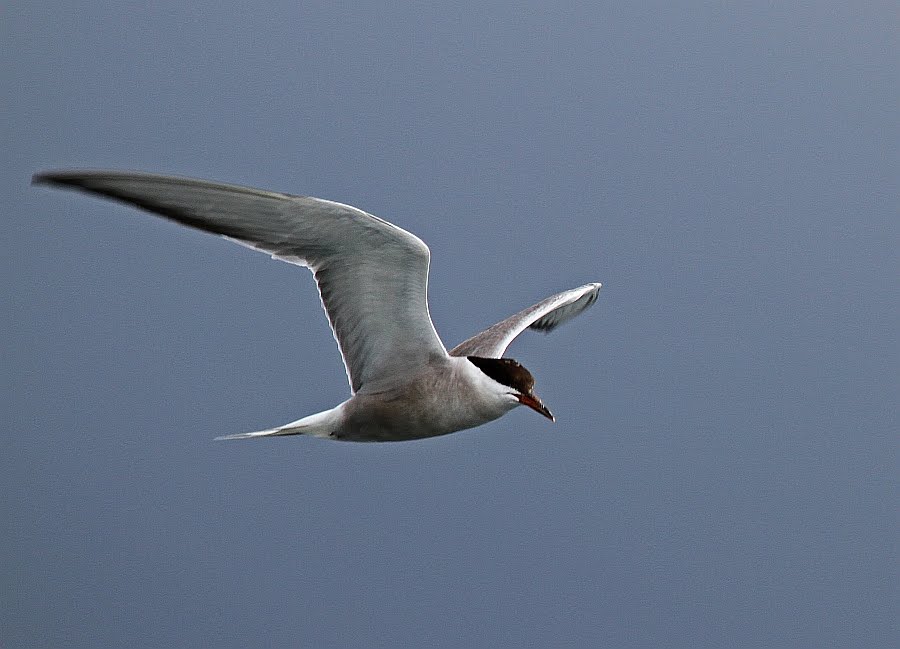


Numbers of Common Terns have not built up yet, with only about 200 in evidence, and, as last month, most were the red-billed 'tibetana' race.


I tried my hand at photographing them from the stern as the birds followed the boat. Pretty tricky!


This one looks like the 'longipennis' race.


Sometimes the birds got a bit close!


Juvenile/first winters have noticeably shorter and more paddle-shaped wings than adults (rear).


A couple of more mature first winters.


Younger birds still have some brown on the forehead and a red bill base.


A couple of Great Crested Terns briefly came to check us out.


They have a jaeger-like, somewhat predatory head-on profile.


This bird appeared to have an almost completely white head.


It didn't hang about.


The last noteworthy sighting of the day was a small pod of dolphins which appeared briefly near the boat. I think these were Irrawaddy Dolphins (I'm happy to have someone confirm or correct this). The pink on the dorsal is either a wound or lack of pigmentation.

Tuesday, September 20, 2011

16 - 18 Sept: Ulu Muda

I finally made a trip to the forests of the north of the Peninsula, with the main aim of seeing Plain-pouched Hornbill.

I went as part of a group staying at Earth Lodge. We had no electricity due to someone helping themselves to a length of cable over the recent holidays, but this proved a very minor inconvenience, as the forest was cool by day and night.


The hornbills didn't disappoint, with regular flights to and from the roost morning and evening; 379 was the best count.


The biggest flocks were over 30 birds, but most were in the 6-16 range.


Photographing them in good light was a challenge due to mist and low sun, but I finally managed to catch this flock on the last morning.

The other highlight was the outstanding number of night-birds around the camp. I estimated 3-4 Reddish Scops-owls, 2 Collared Scops, 1 Brown Hawk-owl, 2 Buffy Fish-owls and one other large owl which called once briefly. Another frustrating once-only call was a probable White-fronted Scops. There were also 3-4 Gould's and 2 Javan Frogmouths in the area. The Reddish Scops, seen briefly and close-up at dawn on our last day, was my second lifer of the trip, and brought my 500 Club list to 555 - which has a nice ring to it!


This male Gould's Frogmouth perched much lower than my only previous sighting.

Some other birds seen crossing the river while waiting for Plain-pouched Hornbills...


One of a party of Great Slaty Woodpeckers.


We counted 27 Large Green-pigeons flying to roost the first evening.


Oriental Pied Hornbills were noisy and obvious!


Oriental Honey-buzzard (top)and Crested Goshawk were among the six raptor species seen.


A Ferruginous Babbler on a rare open perch! The bird activity on the forest trails was good, but the leeches were plentiful and ferocious, and I didn't have adequate protection, which meant I probably spent less time on the trails than I could have!


I am pretty confident the swiftlets which came down to drink in the evening were Black-nest Swiftlets. They had virtually no tail notch, the plumage lacked the warmer brown tones of Germain's, and there was no obvious darker cap, which can be seen on Germain's with good views.


Here's something you don't see every day...a leucistic swiftlet - very cool bird!


A serene sunset on the Muda River. Something tells me I'll be back - once I've got my leech socks sorted!

Sneak peek - September Suara Enggang!


Coming soon!

To subscribe, click on the image in the right hand column.

Sunday, September 18, 2011

22 - 25 August, 2011: Pulau Tengah, Johore

Apologies for the long delay in publishing this post - I've been snowed under work-wise for the past month.

This was my second trip to the island, where Batu-Batu Resort and Wild Asia are working closely together to promote the study and protection of flora and fauna of this small island, located about 9km off Mersing. For more on the project and the island, see this post.

The main purpose of this visit was to see how intern/volunteers Jyun and Hakim have been getting on collecting baseline information on various aspects of the biodiversity of the island and surrounding area. It was still a bit early for passerine migrants, but returning waders were already in evidence.


A view looking at the north-east coastline. Plenty of cover for southward-moving migrants here!


A few more shots from around the island.


The Kraken awakes?


Stunning beauty everywhere you look!


Even the fish 'heart' Pulau Tengah...!


...for infinity!


A Black-naped Tern in front of an approaching storm.


I spent the last morning at the north end of the island trying to photograph the Black-naped Terns there. The low morning light was challenging!


There was a single newly-fledged juvenile being attended by 2 adult birds, including the very abraded individual here.


The juvenile had short, rounded wings, and reminded me of a Little Gull in flight.


The blood vessels in the wing showed pink as the sunlight shone through the wings.


One of the adults showed up with a fish, but was it for the chick or its mate?


The other adult didn't believe in queuing!


In pole position!


This time the juvenile had to wait. Well, they say the best way to love your kids is to show them you love your spouse!


After the fish was exchanged the giver engaged in some sky-pointing, courtship behaviour associated with several birds such as terns and boobies.


A few more terns.


An interesting rock near the terns. It appeared to have a map of England (or is that a mermaid washing her hair??!) and a light bulb etched upon it!


On our return to the mainland, it was good to see that wader migration was already well under way,with over a thousand birds visible, though most were extremely distant. Among the Lesser Sand Plovers, the most abundant species, were good numbers of juveniles, such as this one.


The peach wash on the breast soon fades. When present, it can make juvs look reminiscent of adults in breeding plumage. However, note the broad buff fringes to all the upperpart feathers, which are lacking in adults at this time of year.


Three juveniles and an adult (second from the right). The adult has much more uniform upperpart feathers and is also in wing moult.


A different group, three adults and one juvenile (far right) this time.