We were on a roll from the get-go, with first a brief sighting of an Irrawaddy Dolphin, and then a nice feeding Whale Shark, which the captain obligingly steered over to so we could take a good look!

Just a 'baby', but still an impressive beast!


It was feeding on a shoal of small fish which formed a crescent in front of the vacuum-cleaner-like mouth, so it looked as if was wearing a fishy smile!

Shortly after this fine display, I picked up a tiny white dot flying above the waves. As I got my bins onto it and shouted "Phalarope!" it pitched down; I managed to locate the dot in the camera LCD screen, rattled off a few frames, and by 'chimping' the bird on the LCD, was able to see that it was a juv Red-necked Phalarope - a new Peninsular Malaysian bird for me. Gerry wasn't able to get onto the bird (well, you try giving directions to a tiny bird on the surface of the sea!), but, having seen them far closer in Thailand, was well able to contain the disappointment.

For me, this was a minor triumph - having been on the look-out for the species from the boat for some time now. I knew they must be out there, it was just finding one!

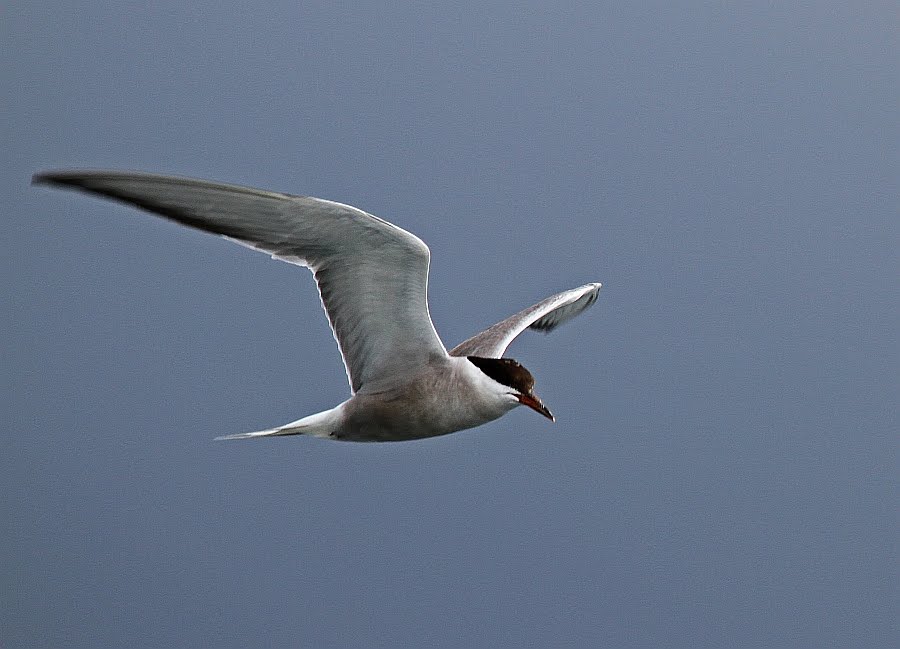
It was obvious that terns numbers were up in a big way compared to last month, and once the net went out, it was Tern Central, giving us superb opportunities to observe the species present from all angles and in most plumages.

White-winged were arguably the most abundant, with 1-2,000 birds present. As soon as the net went out these birds would materialize seemingly out of thin air and descend on the yellow floats holding the net up. It was as if they were just waiting for a place to perch!


Most were adults at various stages of wing moult.


There were a few first winters, but I was especially pleased to photograph this bird (top) still in full juvenile plumage. You don't often see this plumage here.
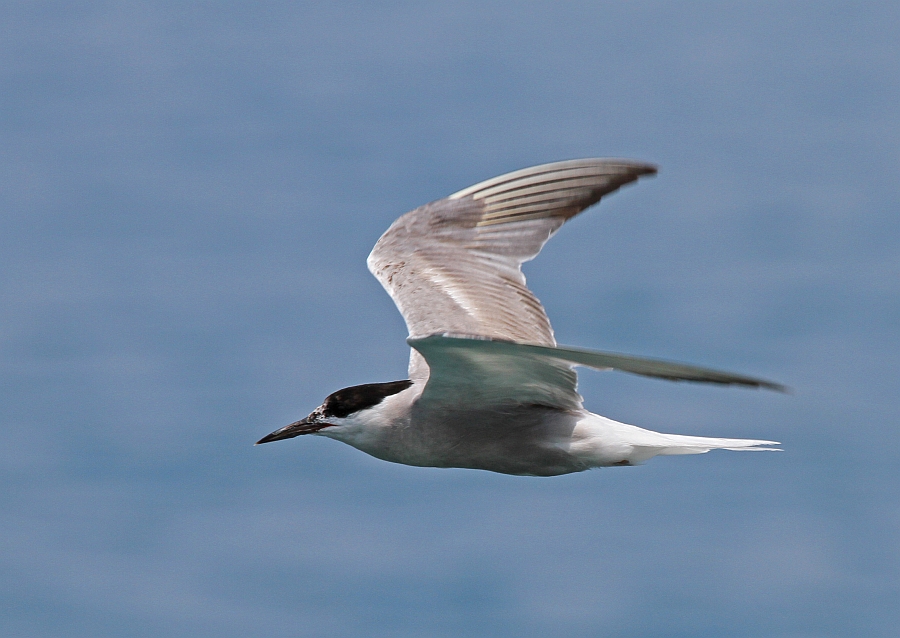


Common Terns had also arrived in numbers - at least 1,000 of these were present.

There were still lots of Bridled Terns about - at least 600 - and I spent a lot of time scrutinizing juveniles, especially the head patterns, after the occurrence of a strange dark-backed tern in Singapore recently (which I'll post more on anon).

I was especially interested in the variation in the pattern of dark and white on the forehead and supercilium, and also in the variation in extent of dark colouration on the throat. This is a fairly standard 'text-book' juv with a well-marked supercilium and plain white throat.

This was a particularly dark individual, which had extensive darker smudging on the flanks and a lightly streaked brown wash on the throat.

It had a typical white 'V' on the forehead, extending over the eye as a short supercilium, and a pale collar.

This much fresher-plumaged bird had a far less obvious supercilium and apparently more restricted white on the forehead.


And this one had nothing you could really call a supercilium at all. It had a fairly large and diffuse white forehead blaze, and a hint of streaking extending down the sides of the throat. This was the darkest-headed bird I could find among the hundreds of juvenile Bridled. None of the juveniles had yet started their body moult into 1st non-breeding plumage.

In fresh plumage, the crown is clearly streaked brown and white. However, when the white edges wear away, the overall effect is to make the crown plainer and darker.


There were more Black-naped Terns than usual - around 50 or so.

Juveniles were plentiful - very smart-looking in black and silver!


In-flight entertainment - Crick-naped Tern!


The scarcer terns were represented by Lesser Cresteds - never more than one in view at any time, but, as these photos show, at least three different birds were present.

There were a few Little Terns around, as well as a solitary and brief Whiskered.
So there were LOTS of terns, but not a great deal of variety. By the time the net was put out for the third time toward 5 o'clock, we were both feeling somewhat hot and weary, having been scanning for 10 hours pretty much constantly. I decided to go up top to get some more juv Bridled Tern pics, and Gerry was one deck down digiscoping (I kid you not, and he got some very respectable pics!) the terns on the net buoys. As I was scanning with my bins, suddenly a familiar but wholly unexpected bird appeared - a LITTLE GULL!!

The first frame!
My mind refused to take in what I was seeing for a split second, before instinct kicked in and I reached for the camera, at the same time shouting - :Little Gull - first for Malaysia!" hoping that this would alert Gerry to the importance of the message. There followed the usual comic miscommunication - "A what?.... A what?" Followed by, "Never mind, just get up here!" Gerry got onto the bird briefly as I got a few more shots, and then the bird vanished into the melee of other birds and into the sun. Confidence that the bird would reappear gradually evaporated as repeated scans drew a blank. Looking at the timing on the camera, the bird had been present for less than a minute, and it had now apparently vanished without trace!


Once we realized that the bird was not among the terns milling around the boat, we stopped to take stock. The bird had been in almost full juv plumage. Although I've seen lots of Little Gulls in the UK, most have been in first winter or adult plumage, and it's been over 15 years since I've seen one. I'd brought Brazil's Birds of East Asia with us, so was able to do a quick check. About an hour after seeing the bird, I had just sat down to write up my notes when Gerry looked up and found the bird again, almost over our heads! By now the light was going, but we were able to make a more leisurely observation, as it hung around for about 10 minutes, before being lost in the wake of the ship.


Spot the Little Gull!
So my second Malaysian lifer of the day was one that was not on my wackiest prediction list! Little Gulls have a northerly breeding and wintering range in Asia (see this map). Brazil reports: "most winter well to the west of [East Asia], but has strayed to coastal Hebei and Jiangsu, Taiwan and several times to Japan; reported Korea." The species sneaked into the latest (2008) edition of Robson's Birds of South-east by virtue of a record in Central Thailand, so, as far as I know, this is the second South-east Asian record, and the most southerly.


Some Common Terns followed us till dark. Thanks to Jerry for forcing me to get out of the office for the day - not a bad result!