Monday, January 15, 2007

Monday 15th January, Bagan Belat and Sungai Dua

Today was a day of awesome birds and awful photos! There was a morning high tide this morning, so I decided to go over and do a count of the Teluk Air Tawar area for the Asian Waterfowl Census.

I got to Penaga paddyfields at about 8am and heard an unfamiliar song coming from the paddies. I quickly located the singer - a Rusty-rumped Warbler (I still prefer Pallas's Grasshopper Warbler, even though the bird sounds nothing like a grasshopper!). I spent some time trying to photograph the bird, and in doing so, came across three Black-browed Reed Warblers as well. I got the impression that there were more Rusty-rumped Warblers singing, but couldn't see or hear more than one at a time. The paddies were abuzz with warblers, with a few Oriental Reed Warblers and Zitting Cisticolas chasing the reed warblers out of their territories.


A Rusty-rumped Warbler tries to sneak away from me.


A lousy picture of a Black-browed Reed Warbler!

At Bagan Belat there were almost no waders in evidence, probably due to a couple of fishing boats close inshore. I drove along toward Bagan Tambang, stopping every now and again to scan the shoreline. At Warung Skot Din there was a small group of Redshanks with a lone Nordmann's Greenshank, but again, numbers were lacking. Finally I arrived at Embun restaurant, to be greeted with a shoreline that was white with shorebirds. The tide was not particularly high - 2.1m, but it turned out to be ideal for a count.

There was one substantial flock, mainly of plovers, close by on the hard mud, and the shoreline was thick with birds, as far as I could see in both directions. It was the biggest flock of waders I've ever seen there.


A shot from the restaurant, showing the nearer and the tideline roost.

I did a preliminary count from the restaurant, and then decided to try to get closer by making my way through the mangroves. The mud was firm underfoot but the trees were densely packed, and several were home to red ant colonies, so I got well-bitten!

Eventually I made my way out to the outer fringe of the mangroves, were I was able to get a reasonable view of the birds. I spent about three hours perusing the flocks. Every once in a while a RMAF helicopter would put all the birds up - truly an awesome spectacle, and quite useful for 'reshuffling the pack'. Even so, the birds were so tightly packed that it was easy to miss birds. Even though there were so many birds, the variety was rather limited, with no knot or godwits of any species. The highlights were a male Ruff, 10 Nordmann's Greenshanks, 5 Eastern Curlew, and a Grey Plover, which I didn't 'see' until I looked at my photos afterwards!
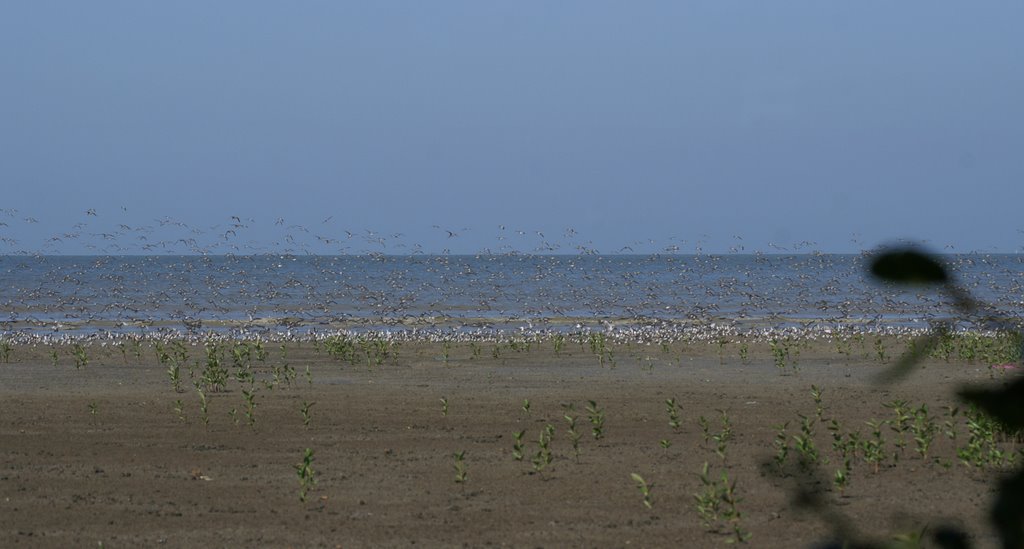


How many Spoon-billed Sandpipers did I miss in this lot? Not for lack of searching!


An impressive spectacle.


Here's the cause of it!

Here's my final count, which was a best estimate given the enormous number and density of birds:

Whimbrel 20
Eurasian Curlew 27
Eastern Curlew 5
Ruff 1
Terek Sandpiper 350
Common Sandpiper 40
Common Redshank 300
Marsh Sandpiper 4
Common Greenshank 10
Nordmanns' Greenshank 10
Red-necked Stint 3,000
Curlew Sandpiper 1,200
Broad-billed Sandpiper 800
Lesser Sand Plover 5,000
Greater Sand Plover 30
Pacific Golden Plover 1,000
Grey Plover 1
Brown-headed Gull 1 ad
Little Tern 150
Whiskered Tern 3
Little Egret 10
Great Egret 50
pond heron sp 26 (those distinguishable were Javan)
Black-crowned Night Heron 1
Little Heron 30

Total: 12,069


Four Eastern Curlews (one far right) among a flock of Eurasians.


A group of Nordmann's Greenshanks, looking ghostly pale against the mud.


Nine Nordmann's Greenshanks with a Terek Sandpiper and a Redshank. Their practically unmarked white tails are striking in flight.


I promised in an earlier entry to post a photo of the underwing of Nordmann's; this may be the best I'll get!


A Grey Plover (top) that I didn't spot or hear in the field, only on my photos! It's a Penang tick for me, but can I count it??!


Head and shoulders above the rest; this male Ruff towers over the surrounding waders.


Ruffs have a curious characteristic of often raising their mantle and scapular feathers.

It had already been a great day, but I decided I would drive over to Sungai Dua, where I hoped I would find some padi being harvested, which always attracts insectivores like hirundines and wagtails, and raptors too. I located a harvester soon enough, but as soon as I set up to watch, the machine broke down! I managed to get brief flight views of a Watercock and Slaty-breasted Rail, and distant flight views of 5 Black Kites.


One of several dozen Red-rumped Swallows around the harvester.

They didn't look like fixing the machine in a hurry, so I drove off in search of other excitement. As I was driving, I saw a Purple-backed Starling land in a small fruiting shrub next to the road. I stopped and waited for it to emerge. As I did so, I noticed a bird hop up from the base of the tree and perch momentarily on a branch in the shade of the tree, before flying out of view into the next shrub. It was only the briefest of glimpses, but I recognized the species from my birding in the UK as a Eurasian Wryneck! A long wait ensued, but it failed to reappear and I began to wonder if I had imagined it! I decided to get out of the car and walk along the drainage ditch it had dived into. Almost immediately the bird flushed and flew past me into a further tree, where I was able to get some distant shots of it perched.


My first 'record shot'.


Showing the characteristic dark brown 'diamond' on the back and nape. Note also the barred tail.


The bird was distinctly furtive, but eventually gave itself up for a couple of decent pics.


One more shot showing the underparts.

After taking this shot I was not able to relocate the bird, despite searching up and down the ditch several times.

When I got home I was amazed to find that the species is not recorded as occurring in Peninsular Malaysia. After birding in Malaysia for many years and not finding any 'firsts', I have now seen potentially four in the last six months - Small Buttonquail, Aleutian Tern, Rosy Minivet and now, Eurasian Wryneck. I guess birding in the north of the country, where there are relatively few birders, has its benefits.

A friend once asked me whether becoming a Christian got me more 'ticks'! I can't say that it ever has, but, having said that, I have made it a habit in the last year or so of asking God to show me what He wants me to see and to teach me what He wants me to learn whenever I go birding, not just in terms of birds, but through all of His creation. So I feel I should give credit where credit is due for this amazing succession of sightings!

Friday, January 12, 2007

Wednesday 10th January, 2007, Tanjung Tokong

With the run of 'low high tides' continuing, I decided that I would at least try and get a count done for the Asian Waterbird Census today.

Upon arrival at the site I saw that there were three men using a pukat out on the shoreline. A pukat is a long fishing net which requires a number of people to operate. It meant that the place where the Malaysian and Kentish Plovers usually hang out at low tide was occupied, and there was no sign of the plovers all afternoon. This was a big disappointment, as I had been hoping to see whether the birds are coming into breeding plumage.

With this out of the question , I decided to spend some time in my Coffin Mk VIII (see here).

This was moderately successful, in that a small flock of Redshanks came and roosted quite close by, and one or two egrets also spent time fishing in front of me, but I found that lighting conditions were not ideal.


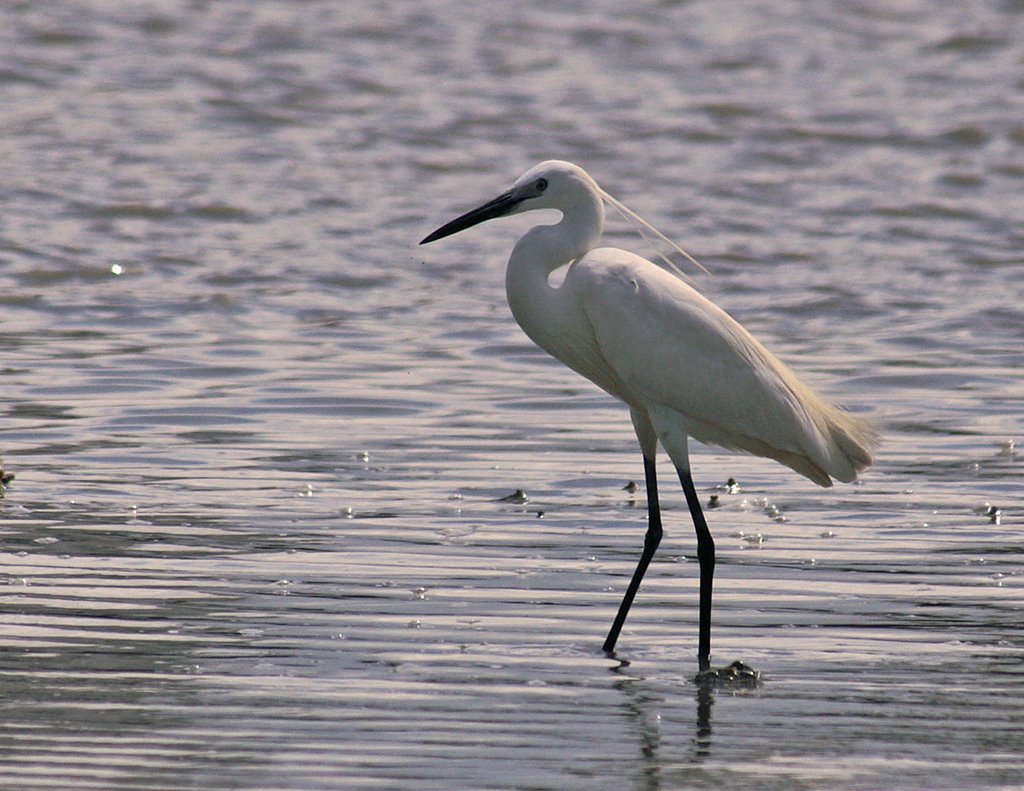
Mudskippers playing catch-me-if-you-can with a Little Egret.


Look out behind you!


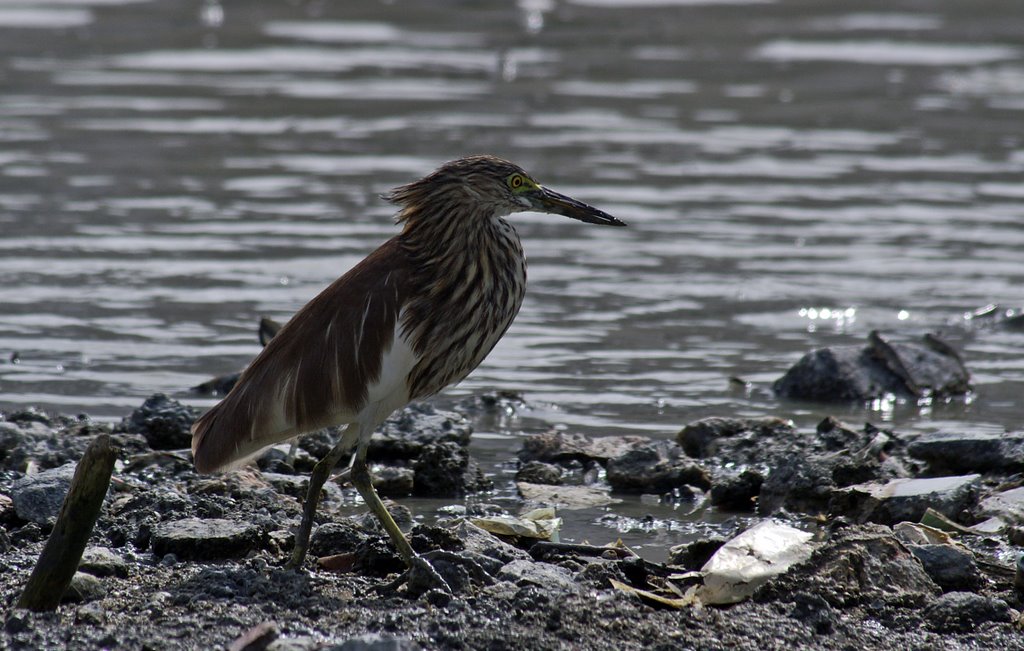
This Chinese Pond Heron is not after health food!


A Great Egret admiring its reflection!

The sun went in and out of some ominously dark thunderclouds, which at times gave some pretty lighting.


Part of the flock of about 120 Redshanks


As usual, the Greenshanks and Marsh Sandpipers kept themselves to themselves


A Redshank incoming


Moving nearer the shore as the tide rises


This one eyed the tyre covetously for about 10 minutes before hopping up on top with what seemed to be an air of smug triumph!


Several birds were busily feeding along the shoreline in the manner of Avocets, running along, bills open, sweeping their heads from side to side.


The extent of plumage variation between some birds was quite striking.


Eventually the clouds blocked out the sun.

The poor light eventually put an end to photographic endeavours, so I returned to the roost site of the other waders (the 'shanks' roost well away from the other waders) to try and do a count.

I got onto the Little Stint that seems to have overwintered here (assuming it's the same bird) briefly before all the birds were put up by a group of Indonesian workers foraging along the shoreline.

The count was a bit disappointing in number and variety:

Great Egret 31
Little Egret 27
Chinese Pond Heron 1
Little Heron 4
Pacific Golden Plover 22
Little Ringed Plover 2
Lesser Sand Plover 2
Greater Sand Plover 1
Red-necked Stint 110
Little Stint 1
Common Sandpiper 4
Marsh Sandpiper 4
Common Greenshank 8
Common Redshank 120

Afterwards I spent some time chatting to the Indonesian workers and showing them the birds through my scope. They said that they were no longer working at the construction site, as their employer had not paid their salaries. So having been brought over here to work, they are left abandoned and incomeless.

Local people frequently complain that house burglaries and petty thefts are committed by Indonesians here. There's an element of prejudice in this view, but no doubt also, some truth. But is it any wonder, I reflected, when there are local contractors who treat their Indonesian workers so unscrupulously?

Saturday, January 06, 2007

Near Grik, Perak, 1st and 2nd January 2007

A couple of weeks ago some birding colleagues had the marvellous good fortune to see and photograph a pair of Asian Tapir in a forest reserve about 2 hours to the north of here. One of them, Tan Choo Eng, subsequently arranged an overnight stay at a logging camp there for January 1st.

We arrived at the camp after breakfast and a leisurely drive at about 10am. Logging in the area has now finished and the camp is now deserted save for a couple of orang asli men. Choo Eng had arranged with the cook for us to stay the night.


This was 'home for us for a night - very pleasant too!

After checking the local Bat Hawks (one was on show), we started birding around the camp. Almost immediately we came across a 'bird wave' - a mixed flock of several species moving through the trees. Among them were many Eastern Crowned Warblers, Bar and Black-winged Flycatcher-shrikes, and a number of Ashy Minivets. Ashy Minivets are quite common winter visitors here. However, while watching the Ashys, we came across another minivet with them that was similar in most respects, but pale yellow where the Ashys were white. The only species we could assign it to was Rosy Minivet, a species that occurs commonly in parts of Thailand in the northern winter, but has not been recorded previously in Malaysia.


Two distant shots of the possible Rosy Minivet. These shots are a bit dark. The bird showed pale yellow underparts, forehead, rump and wingbar on the greater coverts.


A male Pig-tailed Macaque glares at us from the top of a fruiting tree.

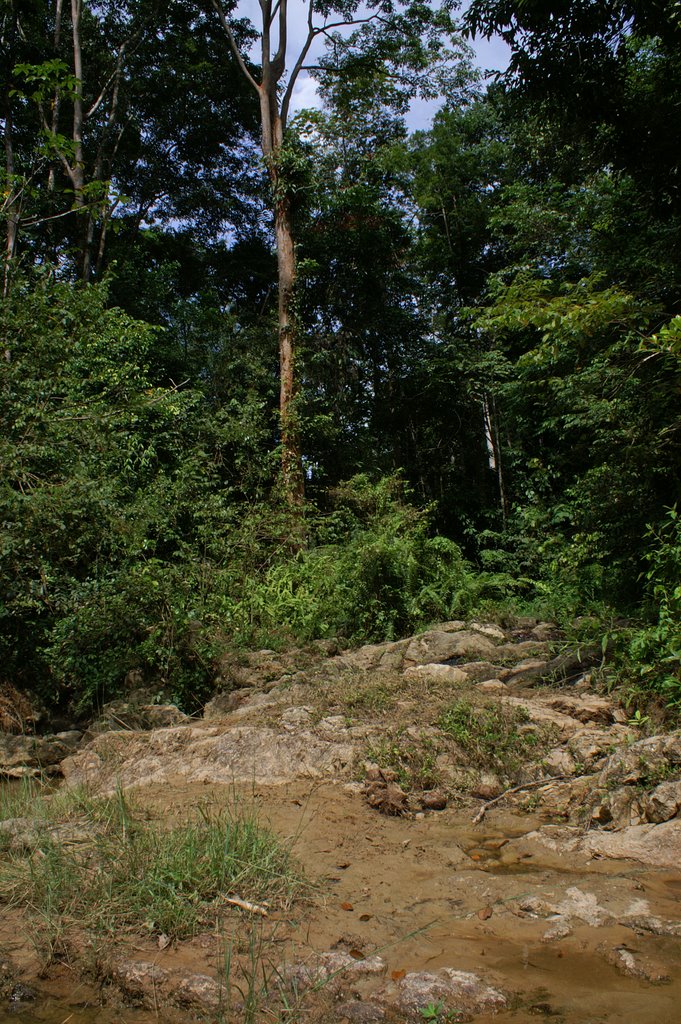
A couple of Wreathed Hornbills flew over the canopy distantly, and then we moved deeper into the forest to where Choo Eng had seen the Tapirs previously. The footprints of both Asian Tapir and Asian Elephant were much in evidence, as well as the dung and pungent odour of the latter. We came across a number of elephant trails moving through the forest to converge on an area of river bank where the animals obviously gather to drink and bathe. There was also an extensive muddy 'wallow' which was much used to judge by the number of footprints. By the river, groups of colourful butterflies hovered around pools of elephant urine.


An elephant trail.


The distinctive three-toed footprint of an Asian Tapir.


Elephant Beach! Note the dung and pools of urine in the foreground. At least they don't leave plastic bags all over the place!


Looking upstream from the previous photo.


We found that there was a surprising number of human visitors to the forest as well. We met a couple of orang asli hunters, equipped with a blowpipe, who showed us a large freshwater turtle that was headed for the pot. We also met and chatted to a group of local bird-trappers, who spent many minutes poring through Choo Eng's field guide, unerringly pointing out and identifying a large number of species they were familiar with. We learned a number of local names from them - Burung Merlau (Blue-winged Pitta), Burung dek-dek (an onomatopeic name for flowerpeckers), and Burung Barau (Straw-headed Bulbul). Their main interest, however, was in Leafbirds (Burung Daun). They accurately identified the three species that are present in this area of forest.

At dusk we spent some time waiting for the Bat Hawks to return to their tree, which they eventually did. Then it was time for a swim in the cool, clear river - heaven on earth after a hot day in the forest!

After a sumptuous meal of sausages, chicken and noodles, we set out for a night foray into the forest once more. We heard the sounds of large animals moving through the undergrowth, but saw very little in the way of wildlife.


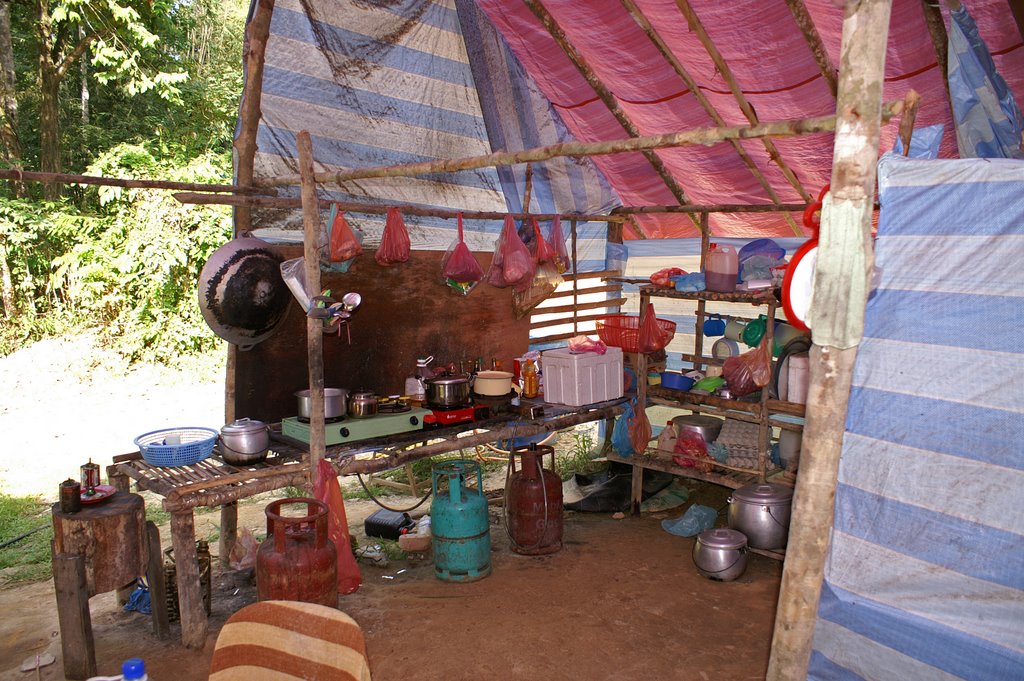
Our kitchen.

By the end of the day we had recorded the following species:
Asian Paradise Flycatcher
Bat Hawk
Eastern Crowned Warbler
Bar-winged Flycatcher-shrike
Black-winged Flycatcher-shrike
Asian Brown Flycatcher
Verditer Flycatcher
Wreathed Hornbill
Spectacled Bulbul
Striped Tit-Babbler
Ruby-cheeked Sunbird
Dark-throated Oriole
Blue-crowned Hanging-Parrot
White-bellied Yuhina
Grey Wagtail
Ashy Minivet
Rosy Minivet?
Great Argus
Crested Goshawk
Brown Fulvetta
Whiskered Treeswift
Dark-sided Flycatcher
Sooty-capped Babbler
Crimson-breasted Flowerpecker
Raffles' Malkoha
Chestnut-breasted Malkoha
Asian Fairy Bluebird
White-rumped Munia
Pacific Swift
Silver-rumped Needletail
Buffy Fish-Owl


The camp by night.


Our sleeping arrangements were basic but good enough for a decent night's sleep.


Early in the morning on Jan 2nd Choo Eng managed to photograph the Bat Hawks mating. Later, near the mud wallow, we photographed a co-operative female Banded Kingfisher, which came to us as we imitated its call. We watched it hunt and catch cicadas for about 15 minutes. During this time we heard several footfalls of elephants in the nearby forest.


We noticed that the bird continually raised and lowered its crown feathers, making it look as if it were permanently raising its eyebrows in surprise!

Birds we added to our list today were:

Banded Kingfisher
Red-billed Malkoha
Scarlet Minivet
Rhinoceros Hornbill
Red-bearded Bee-eater
Black-thighed Falconet
Yellow-bellied Warbler
Lesser/Greater Green Leafbird


A Red-billed Malkoha, located by its curious frog-like croak.

After a final bathe in the river we reluctantly headed back to 'civilization' after an idyllic couple of days close to nature.


A day-flying moth (I think) with a body resembling a hornet drinking at the river.

A quick check at a site en route home yielded a single Small Buttonquail - another species that was only recently recorded in Malaysia for the first time.

Friday, December 29, 2006

Wednesday 27th December

With the disappointing run of poor tides continuing this week, I decided to venture over the bridge for the first time in months to take a look at 'The Far Side'! It rained constantly for the first couple of hours, and with the tide dropping from a pre-dawn 2.1m, I didn't have high hopes of seeing much. Nevertheless I started off at Bagan Belat, which is more or less opposite my patch at Tanjung Tokong, across the strait.

It was good to see quite a few birds I don't get at TT, including Eurasian and Eastern Curlew, Brown-headed Gull and Common, Whiskered and White-winged Terns. There was also a smart breeding plumage Grey Heron. No Nordmann's Greenshanks today, though I didn't expect to see many at this stage of the tide. There was a Eurasian Collared Dove at Bagan Belat, which I assume to be an escaped cage-bird rather than a genuine vagrant. It seemed quite at home in the village environment.

From Bagan Belat I drove several miles inland to the area around Air Hitam Dalam. This used to be a beautiful area of swamp and mangrove along a river. Last year the powers-that-be decided that it should be developed as an 'eco-resort'. Now most of the riverine forest has been cleared, several roads are being constructed through it, and a canopy walkway has been erected through the few remaining trees. Actually, most of the work underway is in the construction of a major road past the area. The eco-resort seems to have been forgotten about. This isn't surprising, as there isn't much left to built a resort around. It all seems such a senseless waste.

I found that one or more likely several owls have been using one of the viewing towers as a roost or nocturnal hunting post, as it was covered with droppings and there were many pellets in evidence. No owls though.


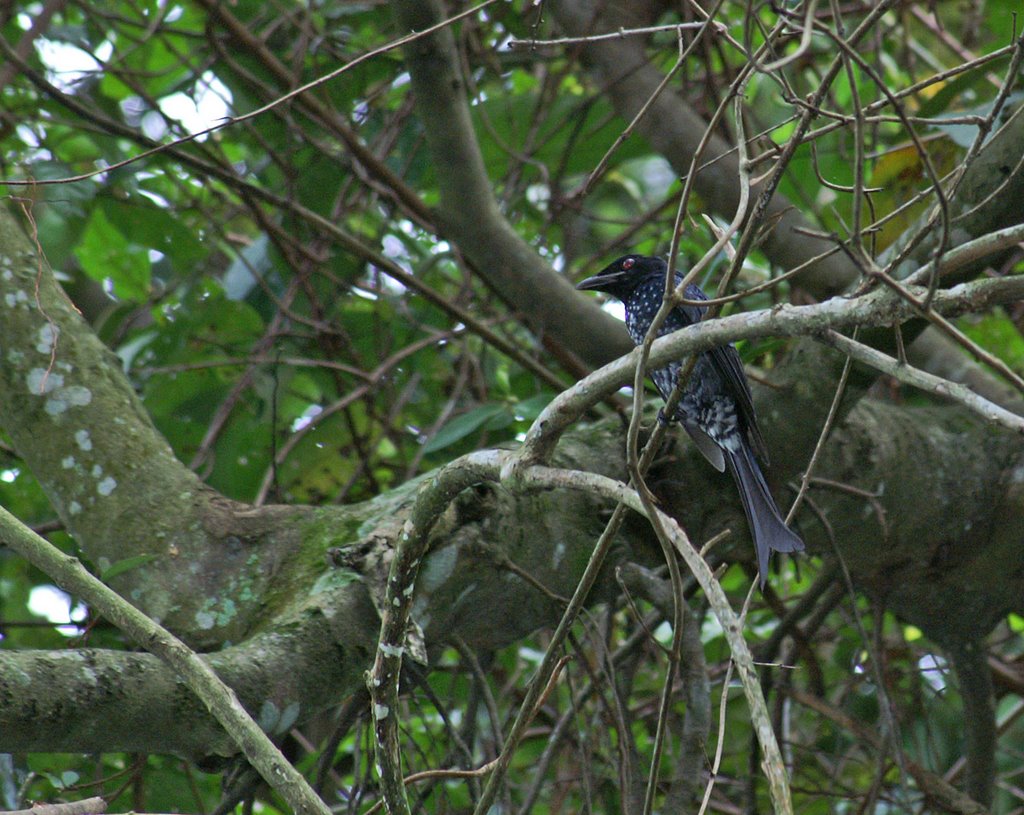
There was a 1st winter Crow-billed Drongo flitting about in the trees, but it mostly kept high up, and out of decent range.


This squirrel was one of several seen here. If you know the speicific identity, please let me know! Thanks.

I spent quite a while driving through the paddyfields in the area. Most of them were full of well-grown green paddy, with just a few open areas where there was standing water. Notable birds were good numbers of Intermediate Egrets among the commoner Little, Great and Cattle Egrets and pond herons, a couple of Black-winged Stilts, a very few Wood Sandpipers, Swinhoe's or Pintail Snipes and a Black Kite.


A graceful Wood Sandpiper in typical habitat.


A 'Swintail' Snipe freezes to avoid detection.


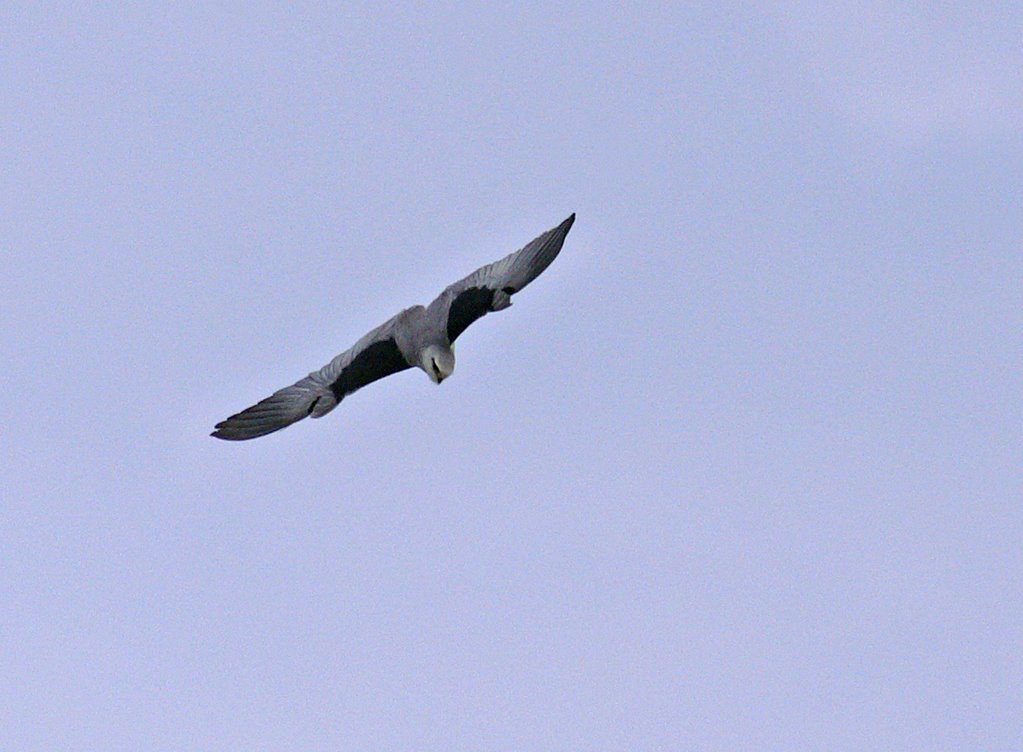
Black-winged Kites hunt very much in the manner of Kestrels; hovering and then swooping down on their prey.


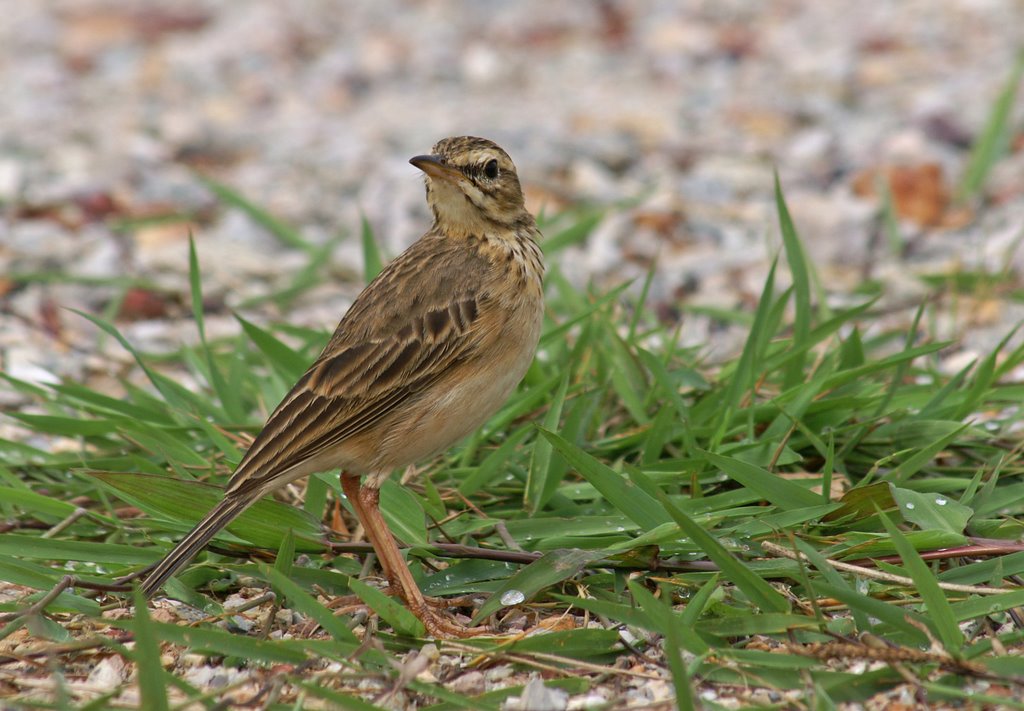
A Paddyfield Pipit just where it should be - in a paddyfield!


Finally, though, I came across an area of paddy being harvested by two huge yellow combine harvesters on caterpillar tracks, and here the air was full of dust and hirundines.


They were mostly Red-rumped Swallows, with many Barn Swallows and at least one Sand Martin. Sand Martin is not on the official list of birds that have been recorded in the state, though I did see one last year.


One of several hundred Red-rumped Swallows.


A Sand Martin. The frequency with which I was able to pick out a lone Sand Martin amongst all the other birds suggested to me that there may have been more than one.


The dark breastband and belly markings rule out the similar Pale Martin, which could conceivably occur.

There were also hundreds of Yellow Wagtails hawking insects on the newly cut paddy-stems. I spent a while looking through them but failed to find a Citrine Wagtail or anything more unusual. Four Black Kites hung on the wind in the hope of catching rats.


What are YOU looking at?! A Blue-tailed Bee-eater stares me down.