Tuesday, June 07, 2011
500 Club New members
A belated welcome to two new members - Nina Cheung and David Lai - who gave me their totals a few weeks ago. In the meantime, recent seabird forays have seen quite a few lists growing rapidly, including those of James, Mun, Carol and Swee Seng. Another recent lifer for Seng and Carol was Eye-browed Wren-babbler, while I have added one more to my total, of which more later!

Monday, June 06, 2011

Saturday, June 04, 2011

Thursday, June 02, 2011
19 - 21 May, Batu-batu Resort, Pulau Tengah, Johore
I was invited to visit this new resort on Pulau Tengah as part of a team who are putting together a new exciting project - BRISC for short, or Batu-batu Reef and Island Study Centre for long! Take a look here for how the resort is taking shape.

The three most obvious 'tracks' for BRISC are 1) the reefs and corals, 2) turtles, and 3) birds. The latter is where I came in! Though the island is quite small, about 2 square km, it is strategically situated in the South China Sea, and I expect that it will prove to be a magnet for migrating birds, especially in the southward migration season (Sep - Nov), as well as a good jumping off point for pelagic forays for seabirds.
Here are a few pics from my three days of heaven-on-earth!

Boy - this was a tough assignment!

But someone had to do it!

Here's the view from my room.

At one end of the island there's a rockpool 'garden' at low tide. I'm no good at marine stuff, but here are a few things I found in the pools:

An anemone ... sounds like the beginning of a tongue-twister!

Another kind of coral.
Some fishies...


Big fish, small fish, blue fish, fat fish... now I sound like a Dr Seuss book!

This is a Ghost Crab I think.

And this very cool creature looks like a clam.

Native bird life on the island is quite sparse, but a fruiting fig near the chalets was a hive of activity each morning. This is a female Brown-throated Sunbird.

Undisputed stars of the show each morning were a flock of Pied Imperial Pigeons. There's no known sexual dimorphism, but there were two distinct plumage 'types', as can be seen here. Wells notes that "the white parts of fresh-plumaged adults are flushed ivory-cream, perhaps by preening from lipid-producing feathers". So maybe the ivory-white birds were subadults.

It was the creamy birds which most drew my attention. In the golden early morning light, they were truly stunning creatures!

It was the ripe, pink figs they were after!

I was amazed at how broad the bill is - obviously tailor-made for walloping fruits in one gulp!

Down the hatch and after another!

The light filtering through the wings made it look as if the bird had golden underwings!


Another fig swiftly dispatched!

The unexpectedly gorgeous Pied Imperial Pigeon!


A couple of flight shots showing the distinctive wing and tail pattern.

A few Pink-necked Green-pigeons crashed the party. They didn't have a big enough beak to swallow the fruits whole, so things got a little messy - and each sported a bright pink forehead as a result of staining from the fig juices.

But it blended right in with the rest of their colour scheme!

Pacific Reef-egrets are among many species which island-hop.


We took a small boat out one day to prospect some of the smaller islets in the archipelago. Plenty had Black-naped Terns on them.


The bird with the smudgy mask and grey spots on the wingtips is a one-year old bird. The others are adults.

They're iconic birds in flight!

I was hoping to find some Roseate Terns, and eventually we had brief views of a pair which flew overhead, mobbing the Black-naped.


I was surprised at how much red was on the bill, compared with an adult we saw recently on the west coast. I suppose it must be a feature of birds in breeding condition.

A sea cave on one of the nearby islands.


A yellow Chinese lantern moon.With so little artificial light, the island would be a great place to star-gaze.
For more information on BRISC and Batu-batu resort, see the website and Facebook page. As well as a full-time Divemaster, we're looking for volunteers to a) monitor bird migration on the island and b)conduct pelagic seabird surveys on board local fishing vessels this autumn, from September - November. If you'd be interested in being a volunteer for part or all of this time, please email me!


The beach at Mersing still had a decent flock of non-breeding waders - mostly sand plovers and Terek sandpipers, but with a few Ruddy Turnstones and a single Red-necked Stint which you should be able to spot in the flight shot.

The three most obvious 'tracks' for BRISC are 1) the reefs and corals, 2) turtles, and 3) birds. The latter is where I came in! Though the island is quite small, about 2 square km, it is strategically situated in the South China Sea, and I expect that it will prove to be a magnet for migrating birds, especially in the southward migration season (Sep - Nov), as well as a good jumping off point for pelagic forays for seabirds.
Here are a few pics from my three days of heaven-on-earth!

Boy - this was a tough assignment!

But someone had to do it!

Here's the view from my room.

At one end of the island there's a rockpool 'garden' at low tide. I'm no good at marine stuff, but here are a few things I found in the pools:

An anemone ... sounds like the beginning of a tongue-twister!

Another kind of coral.
Some fishies...


Big fish, small fish, blue fish, fat fish... now I sound like a Dr Seuss book!

This is a Ghost Crab I think.

And this very cool creature looks like a clam.

Native bird life on the island is quite sparse, but a fruiting fig near the chalets was a hive of activity each morning. This is a female Brown-throated Sunbird.

Undisputed stars of the show each morning were a flock of Pied Imperial Pigeons. There's no known sexual dimorphism, but there were two distinct plumage 'types', as can be seen here. Wells notes that "the white parts of fresh-plumaged adults are flushed ivory-cream, perhaps by preening from lipid-producing feathers". So maybe the ivory-white birds were subadults.

It was the creamy birds which most drew my attention. In the golden early morning light, they were truly stunning creatures!

It was the ripe, pink figs they were after!

I was amazed at how broad the bill is - obviously tailor-made for walloping fruits in one gulp!

Down the hatch and after another!

The light filtering through the wings made it look as if the bird had golden underwings!


Another fig swiftly dispatched!

The unexpectedly gorgeous Pied Imperial Pigeon!


A couple of flight shots showing the distinctive wing and tail pattern.

A few Pink-necked Green-pigeons crashed the party. They didn't have a big enough beak to swallow the fruits whole, so things got a little messy - and each sported a bright pink forehead as a result of staining from the fig juices.

But it blended right in with the rest of their colour scheme!

Pacific Reef-egrets are among many species which island-hop.


We took a small boat out one day to prospect some of the smaller islets in the archipelago. Plenty had Black-naped Terns on them.


The bird with the smudgy mask and grey spots on the wingtips is a one-year old bird. The others are adults.

They're iconic birds in flight!

I was hoping to find some Roseate Terns, and eventually we had brief views of a pair which flew overhead, mobbing the Black-naped.

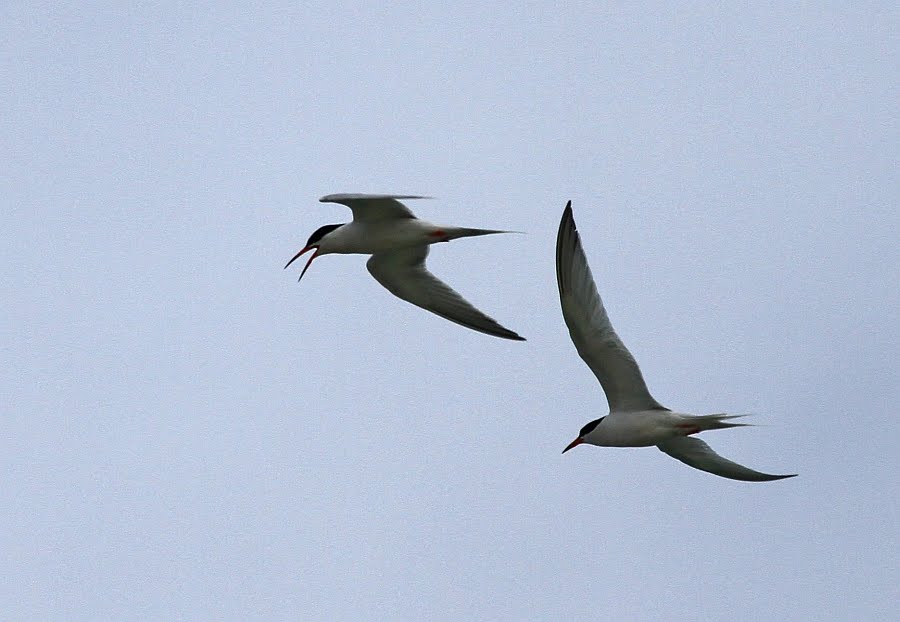
I was surprised at how much red was on the bill, compared with an adult we saw recently on the west coast. I suppose it must be a feature of birds in breeding condition.


A sea cave on one of the nearby islands.


A yellow Chinese lantern moon.With so little artificial light, the island would be a great place to star-gaze.
For more information on BRISC and Batu-batu resort, see the website and Facebook page. As well as a full-time Divemaster, we're looking for volunteers to a) monitor bird migration on the island and b)conduct pelagic seabird surveys on board local fishing vessels this autumn, from September - November. If you'd be interested in being a volunteer for part or all of this time, please email me!


The beach at Mersing still had a decent flock of non-breeding waders - mostly sand plovers and Terek sandpipers, but with a few Ruddy Turnstones and a single Red-necked Stint which you should be able to spot in the flight shot.
Tuesday, May 24, 2011
Amazing wader, West Kalimantan

This photo was taken by Abdurahman Al Qadrie in West Kalimantan in early April this year. Thanks to Pak Abdurahman for permission to post the photo on my blog, and to Bas van Balen for drawing my attention to it.
Pak Abdurahman thought he was looking at a Common Greenshank till the bird flew, when it revealing this amazing wing pattern.
I believe it is a Common Greenshank, showing an extraordinary form of leucism. What do you make of it?
Thursday, May 19, 2011
Peninsular Malaysia Checklist now online!

A Checklist of the Birds of Peninsular Malaysia was published by the Malaysian Nature Society last year as MNS Conservation Publication no.10. A downloadable.pdf format file of the checklist is now available at the MNS-BCC Records Committee website. Thanks to Wilbur Goh, the RC Secretary, for uploading the pdf!
The online checklist will be updated periodically (there have already been four additions to the list since it was published), so check for revisions from time to time.
Tuesday, May 17, 2011
16th May 2011: Chartered pelagic, Tanjung Dawai, Kedah
This was the second chartered pelagic trip to go out from Tanjung Dawai in three days. On the first, the group had seen many Short-tailed Shearwaters but little else. However, on the same day, a pelagic off Singapore had recorded good numbers of Swinhoe's Storm-petrels, so we were hoping for greater things!
In the end though, apart from a distant Long-tailed or Parasitic Jaeger, we couldn't improve on the 'catch' of the first trip, and in fact, only saw 3 shearwaters, so it seems that the northward migration is winding down.
Still, we were very happy to get excellent views of the birds we did see. A few pics below:


Of course, the shearwaters were the star attraction, and no one could complain about the views we had!


Seeing them today I realized that the body feathers are worn, not fresh as I'd thought earlier. This last bird was in a particularly worn state, as can be seen by the water-logging of many of the body feathers.


It was instructive to see how their appearance could change with posture. The upper bird is relaxed, and seems to show a rounded, large head and shortish, thick bill. The lower one is alert, and has stretched its neck and flattened its feathers close to the body, giving it a squarish headshape and making it look small-headed and long billed.


Some hunting shots:


This would have been my "National Geographic shot' if only the fish had been in focus!

This was the next frame - so the fish escaped - this time!
Some Black-naped Terns...


There were not many Common Terns around, but this was an interesting bird. I'm guessing it's a 2nd summer - possibly 'tibetana', though it could be 'minussensis', which is supposed to have characteristics intermediate between 'longipennis' and 'tibetana'.


The best of my efforts at the breeding plumaged White-winged Terns.

A nice place to stop for our lunch and a short swim.

Flushed with success! A satisfied (and rather pink!) team head back to port after a full day in the sun!
By the way, for anyone thinking of exploring pelagic birding in new areas, there's an excellent article on how one can go about starting up here.
In the end though, apart from a distant Long-tailed or Parasitic Jaeger, we couldn't improve on the 'catch' of the first trip, and in fact, only saw 3 shearwaters, so it seems that the northward migration is winding down.
Still, we were very happy to get excellent views of the birds we did see. A few pics below:


Of course, the shearwaters were the star attraction, and no one could complain about the views we had!


Seeing them today I realized that the body feathers are worn, not fresh as I'd thought earlier. This last bird was in a particularly worn state, as can be seen by the water-logging of many of the body feathers.


It was instructive to see how their appearance could change with posture. The upper bird is relaxed, and seems to show a rounded, large head and shortish, thick bill. The lower one is alert, and has stretched its neck and flattened its feathers close to the body, giving it a squarish headshape and making it look small-headed and long billed.


Some hunting shots:


This would have been my "National Geographic shot' if only the fish had been in focus!

This was the next frame - so the fish escaped - this time!
Some Black-naped Terns...


There were not many Common Terns around, but this was an interesting bird. I'm guessing it's a 2nd summer - possibly 'tibetana', though it could be 'minussensis', which is supposed to have characteristics intermediate between 'longipennis' and 'tibetana'.


The best of my efforts at the breeding plumaged White-winged Terns.

A nice place to stop for our lunch and a short swim.

Flushed with success! A satisfied (and rather pink!) team head back to port after a full day in the sun!
By the way, for anyone thinking of exploring pelagic birding in new areas, there's an excellent article on how one can go about starting up here.
Subscribe to:
Posts (Atom)