Showing posts with label Kinabatangan. Show all posts

Wednesday, April 07, 2010

30th March 2010: Lower Kinabatangan, Gomantong Caves and Sepilok

Our last morning at KJC was spent on another excursion to look for the ground-cuckoo.


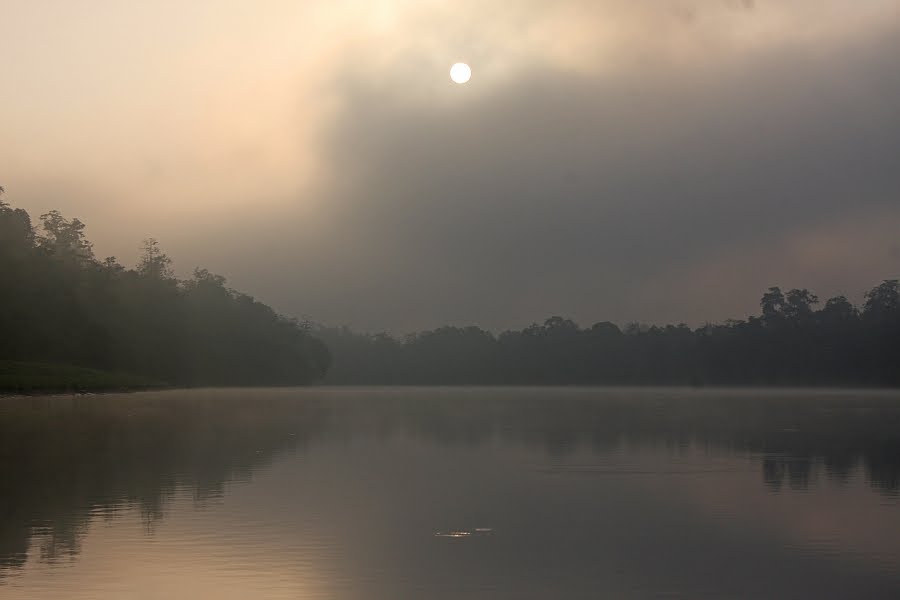
The river just after sunrise.


One of our first birds was this Storm's Stork feeding rather close to the water's edge.


It flew up into a nearby tree at our approach, so we probably saved it from being a croc's breakfast!


Have a guess what this is!


Taking a morning bath at speed!


Did you guess right? A pair of Brown-backed Needletails came down to bathe near our boat. This stunning performance was one of the highlights of my whole trip. Sadly neither the camera nor the photographer were quite up to doing the whole experience justice!


Turning up the creek to look for ground-cuckoos, I finally got a shot of an Oriental Pied Hornbill in good light. This is a male.


Wood Nymph butterflies have a unique slow fluttering wing action. This one went right over us!


Black-naped Monarchs are commonly heard, but less easy to see well. This male had just had a dip in the river and was finishing off his morning ablutions.


We came to a log that had fallen across the creek, effectively turning it into a cul de sac. This Oriental Darter found itself caught between us and the fallen tree, and wasn't quite sure what to do, enabling us to get great views of it.


The tertials and tail feathers are quite extraordinary. They look as if they're made from PVC rather than feathers!


Eventually the bird had to move, so it opted to fly as far as the fallen log.


It then sank out of sight like a submarine diving, only to appear from the neck up near the bank, trying to look inconspicuous.


Finally, it decided to make a dash for freedom, so with much flapping and splashing, it took off and flew past us. Fantastic!


Meanwhile on the fallen tree itself, a troop of Pig-tailed Macaques were sunning themselves. These youngsters were busily quarrelling, quite oblivious to us.


They made friends again later!


I started to feel guilty under this one's reproving stare!


I decided this one must be a teenager!


On our way back we came across this female Rufous-tailed Shama carrying food. Robert told us that this is a rare bird here - more rarely seen than the ground-cuckoo in fact...! This was not much consolation for the continuing silence from the cuckoos.

We had brief views of Scarlet-rumped Trogon and a Hooded Pitta, but otherwise, the birds were much the same as yesterday, until...


...Robert pointed out a couple of White-fronted Falconets - two males. My first lifer since arriving in Sabah!


Fairly high up, but that's quite typical of falconets I guess!

Oh well, plenty to come back for, which I certainly plan to. The Lower Kinabatangan is one amazing place!

En route back to Sepilok, we stopped to look at a few birds...


...a Striated Grassbird


...and several Bat Hawks. Bat Hawks were about the most frequently encountered raptor on my trip. I counted 7 birds between Kinabatangan and Sepilok. Every mengaris (tualang) tree seemed to have at least one bird, even if the tree was the only one standing in a sea of oil palm.


We stopped off at Gomantong Caves so that we could tick off Edible-nest, Black-nest and Mossy-nest Swiftlets (pic), which can all be safely identified as they sit on their distinctive nests. The rain made the steps in the cave treacherously slippery, and the handrails were not much help, being covered in guano and crawling with cockroaches. The stench of ammonia from the guano in the cave was pretty powerful.

Also en route back to Sepilok, we stopped and scanned a weedy pool in an oil palm estate. It only had five Common Moorhens and a Little Grebe on it, so we didn't spend much time there. It was only when we reached Sepilok and I checked Myers that I realized that there are only a small handful of records of Little Grebe from the whole of Borneo, and that it was undoubtedly the rarest bird of the trip!


Back at Sepilok just before dusk, we made for the Bristlehead Tower again. I got another chance to photograph the male Scarlet-backed Flowerpecker, and another chance to miss Bristlehead! The flying squirrels weren't in the mood tonight either - only a couple appeared long after dark.


After dinner we went out to try for night mammals and birds. Our success was limited - a few Brown Hawk-owls, this Colugo...


...and a roosting Black-backed Kingfisher, looking like a gem in the spotlight!

So, four mornings and four evenings at Sepilok produced no Bristleheads, three days at KJC produced no ground-cuckoos, and in the whole trip I only saw one new bird! Nevertheless I was well-pleased with this trip, and it gives me a good excuse to go back again!

29th March 2010: Lower Kinabatangan River, Sabah

I was hoping for some blue skies to get better shots of hornbills today, but the early signs were not promising!


KJC in the pre-dawn murk


The dining area, waiting for breakfast!


The river at dawn.


Front to back, Dieter and Alicia Kamm, a birding couple from Arizona, Robert Chong, and our expert driver. Our main targets for the trip were Bornean Ground Cuckoo and Giant Pitta, and other possible lifers for me were Great-billed Heron, Jerdon's Baza and White-fronted Falconet.


Heading into Ground-cuckoo territory, the weather did not look promising!


But the sun began to burn off the early morning mist, and things began looking up weatherwise.


It's not just bird photographers who use hides - birds use them too! This Blue-eared Kingfisher appeared to be camouflaging itself behind these three leaves.


The orange lower mandible marks this bird as a female.


Here's a male.


A Malaysian Blue Flycatcher of the endemic race 'turcosus'. Surprisingly, this bright-plumaged bird is a female.


Males have a blue throat. These flycatchers and the kingfishers are the standard common birds of the riverbanks here.


We watched nine Rhinoceros Hornbills follow each other across the river. From the development of their casques, they all looked like subadult birds. Here's the first, a male (red iris)


Next was a young female (whitish iris)


Number three was a more mature? female (white iris)


I guess this could have been an adult female, as the iris is brilliant white, but the casque doesn't curl backwards at the tip.


Number 5 was a young male


Number 6, another male


Another female.


And number 8, another female. Somewhere in the excitement I forgot to photograph number 9!


A juvenile Oriental Pied. I seemed to have timed my visit to coincide with the end of a breeding cycle


Oriental Darters are quite common but also very shy and difficult to get close to

Forest birds in general were exceptionally quiet - we only heard one pitta - a Hooded briefly, and there was not a squeak out of the ground-cuckoos.


As we headed upriver for lunch, several Storm's Storks and Lesser Adjutants (pic) could be seen thermalling high in the sky.


Back at the camp, butterflies swarmed over any patch of dampness. Walking through them, we were enveloped by clouds of living confetti!


If you come to Malaysia as a tourist, it's a good idea to learn some basic Bahasa Malaysia, the national language. Here's a useful little sign. Let me give you a quick language lesson.

"Awas" means "Beware!"

"Berhati-hati" means "Be careful!"

Getting the message?

"Sungai" is river, so "Sungai ini ada buaya" means "This river has buaya."


This is a buaya! A big buaya!


And this is why it's a good idea to learn the meaning of "Awas" and "Berhati-hati"! We witnessed an almost fatal and shockingly fast attempted ambush of a Long-tailed Macaque which had strayed too close to the river bank. One moment there was just a monkey taking a drink, the next the water erupted and the monkeys leapt back with much shrieking. The attack was too fast for our eyes to see the outcome, but afterwards a lack of blood in the water showed that the macaque had lived to tell the tale. Perhaps it should learn to read.


Birdwise the afternoon was even quieter than the morning. A male Black Hornbill was one of few highlights.


Followed a little later by a female.


We were lucky to get close views of this Lesser Fish Eagle. These were generally shy, keeping well ahead of our boat. I think this one had been disturbed by another boat further downstream.


A resting Mangrove Snake, which I think is also known as Yellow-banded Cat Snake.

At this point we even began to try to photograph the Slender-billed Crows, but the light was too bad to get any decent shots. On our way back to camp we got brief views of a medium-sized raptor carrying prey which flew across the river and disappeared into the forest. At the time we dismissed it as a Crested Goshawk, but my blurry photos suggest it was more likely to have been a Jerdon's Baza. Oh well!


No sign of Elizabeth the badger after dinner, but we were entertained by another regular customer - Tom the Malaysian Civet.