Showing posts with label booby. Show all posts

Sunday, July 01, 2012

Joining the dots: the Peninsular Malaysia marine boundary

With more and more interest in and information on pelagic birds in Malaysian waters, sooner or later, I thought, we will need to work out exactly where Malaysia ends and neighbouring territories begin!

So I spent a few hours this afternoon doing a complicated dot-to-dot exercise, mapping the coordinates from this site: http://en.wikipedia.org/wiki/Borders_of_Malaysia onto a Google Earth map. I've only managed to finish Peninsular Malaysia so far - East Malaysia will have to wait for another Sunday afternoon!


Here are the results of my labours! The entire peninsula sits on a continental shelf of relatively shallow water, meaning that we are unlikely ever to ever see any of the deep ocean pelagics (e.g. albatrosses!). Nevertheless, there are exciting possibilities for the adventurous to get reasonably far offshore and into the Andaman and South China Seas, especially off the northern state coasts.

The reason I was especially motivated to draw this map is that there have been, not one, but TWO Red-footed Boobies off the coast of Malaysia in May and June, and I was eager so see whether either qualified as a 'Malaysian bird'!

The first was seen during a pelagic survey from Singapore on 13 May. It was first sighted here:

Definitely in Malaysian waters! Happily for the Singaporean observers, the cooperative bird flew over into Singapore waters too, so they could add to their national list!

The second was seen on 14 June by Peter Ryan on board the RV Marion Dufresne in the Straits of Malacca, just here:
So close! Just the 'wrong' side of the border, as far as Malaysia is concerned! Peter has generously allowed me to reproduce some of his amazing photos here.
If you were expecting a dot on the horizon, you'd be wrong!This bird is a little older than the Straits of Singapore bird, and is safely identifiable as a different individual. Peter also got some enviable opportunities to photograph frigatebirds in the Straits of Malacca too (also just outside Malaysian territory).

A juvenile Christmas Island Frigatebird,, identified by the ‘hexagonal’ shape of the belly patch and the white axilliary spurs pointing forward from around the middle/front of the belly patch. The small white spot on the upperwing is also supposed to be diagnostic. (thanks to Nick Brickle for supplying these helpful notes).
A third year female Lesser Frigatebird. Details again from Nick: a third-year female Lesser with plumage that is somewhat transitional between a Juv and an Ad female Lesser. The belly patch is heavily mottled in a way that is consistent with it becoming the shape of an Ad Fem Lesser. The axilliary spurs are prominent, white and triangular. The breast band seems to have faded and the black feathering around the bill is probably a hint of the black hood to come.

SO...an intriguing taster of what is out there. Next step - a pelagic west of Langkawi, or - the Holy Grail - out to Pulau Perak...anyone??

Sunday, October 09, 2011

Sept 21 2011: At sea, off Tanjung Dawai, Kedah

This was my first trip out in September (we have between us now covered all the other months of the year), so I was somewhat hopeful, especially as there had been a count of 510 Swinhoe's Storm-petrels off Singapore the previous weekend!

The weather was nice too - proper seawatching weather, with a succession of rain squalls pushing birds toward the coast. Things looked good!


Great Crested and Common Terns vying for space on the fish-traps close inshore in the early morning. There had been rain overnight and more looked likely!


Rain coming.


Rain arrived!


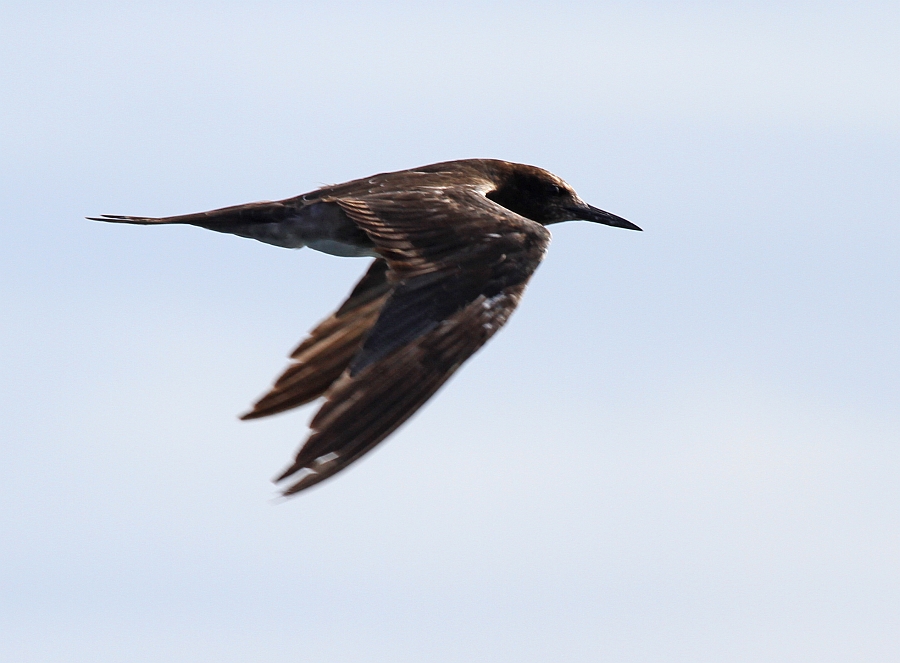
Before one of the squalls hit, I was rewarded by the magnificent sight of three Brown Boobies arcing high over the sea heading toward the coast!


I've seen Brown Boobies closer than this before, but never so much 'in their element' like this, enjoying the wind and behaving like real ocean-going birds - fantastic!


This is one of the other birds - looking rather heron-like with almost no tail. All were subadults, perhaps from Pulau Perak, which is about 200km to the south.


Later on, one of the birds came to feed around the net.


Point of entry. Amazing how thin they make themselves as they enter the water! Whenever I've seen Brown Boobies fishing, they always dive at a shallow angle like this, and from only a few feet above the water. Maybe this is because their prey is near the surface, but it is different from how I remember Northern and Australian Gannets hunting; I only recall seeing them diving from much higher above the water and almost vertically.

That was pretty much it, as far as interesting seabirds was concerned. No petrels sadly, though plenty of Bridled Terns - I estimated over 400, including many fresh juveniles. The Singapore pelagic had recorded about 500, clearly on passage. In our case, it's harder to see that birds are migrating, since we mainly see them milling around the nets and feeding, but a quick calculation of maximum numbers we've recorded by month reveals that September is one of the two peak months in the year.


Adults.


Juveniles.


A study in contrasts. A 1st winter Common Tern (left) with an adult Black-naped Tern.


Black-naped seem to shine against the dark rain clouds!


Numbers of Common Terns have not built up yet, with only about 200 in evidence, and, as last month, most were the red-billed 'tibetana' race.


I tried my hand at photographing them from the stern as the birds followed the boat. Pretty tricky!


This one looks like the 'longipennis' race.


Sometimes the birds got a bit close!


Juvenile/first winters have noticeably shorter and more paddle-shaped wings than adults (rear).


A couple of more mature first winters.


Younger birds still have some brown on the forehead and a red bill base.


A couple of Great Crested Terns briefly came to check us out.


They have a jaeger-like, somewhat predatory head-on profile.


This bird appeared to have an almost completely white head.


It didn't hang about.


The last noteworthy sighting of the day was a small pod of dolphins which appeared briefly near the boat. I think these were Irrawaddy Dolphins (I'm happy to have someone confirm or correct this). The pink on the dorsal is either a wound or lack of pigmentation.

Saturday, June 18, 2011

16th June 2011: At sea, off Tanjung Dawai, Kedah

I had made arrangements to take a Star reporter and photographer on the boat today, so it was a good excuse to go out and see what was still around. There had been a major storm the previous day and there was still quite a swell for most of today, and I think it brought the birds in too!


The first interesting bird of the day approached the boat from the rear, and for quite a while I had no idea what it was!


Fortunately it kept coming closer, and eventually revealed itself to be an immature Sooty Tern. What was interesting was that the bird apparently showed white in areas where even adults don't normally show white. For example, the extent of white on the forehead and crown was way more than would appear on an adult (being suggestive of a Noddy sp).


The white colouration on the outer primary coverts on the distant shots proved, on closer inspection, to be light reflecting off dark feathers.


The apparent pale grey on the inner primaries visible on the distant shots was the effect of light reflecting off freshly moulted adult-type inner primaries, which are covered with a lustrous silvery sheen (see the pics of adults on this post). I judged this bird to be a different individual from the one seen last on 4th May, as that bird was in pretty fresh plumage - I doubt so much wear could take place in the space of just over a month.


When the net was put out, I saw what I initially took to be another imm Sooty.


On getting better views, I realized that it was a Bridled, unfortunately oiled on its head and underwing.


Bridled Terns were overwhelmingly the commonest species in evidence today - around 200 at the net.


There was an interesting array of plumages on view; the lower of these two has lost most of its greater coverts and some lesser and primary coverts, exposing the white bases of the feathers beneath, leading to a very piebald appearance. Glad to see it has started to moult - otherwise it might soon be flightless!


Adults breeding-types had all but completed wing and tail moult (p10 and the outermost right hand tail feathers were still growing).


Most of the non-breeding plumaged Bridled were at a similar stage of wing moult to this bird, with all but the outer one or two primaries replaced (compared to 5-6 unmoulted on 4th May).


I was very surprised when the Brown Booby showed up again! Undoubtedly the same bird as the one first seen by me on 27th April (but probably present since February according to fishermen's reports) and last seen on 10th May.


It put on a superb show today, doing several close fly-pasts and joining the terns to feast on the fish in the net.


It has started its tail and wing moult, and seems to have replaced the central pair and the outermost pair of tail feathers - odd!


It's replacing some nape feathers too by the look of it.


A few more!


Two of the Short-tailed Shearwaters were still around - perhaps they'll stay to complete their moult.


The adult Roseate Tern was another 'old friend'. It still seems very much warier than the other terns, but it did come a little closer today.


Check out the out-sized conk and long black mane!


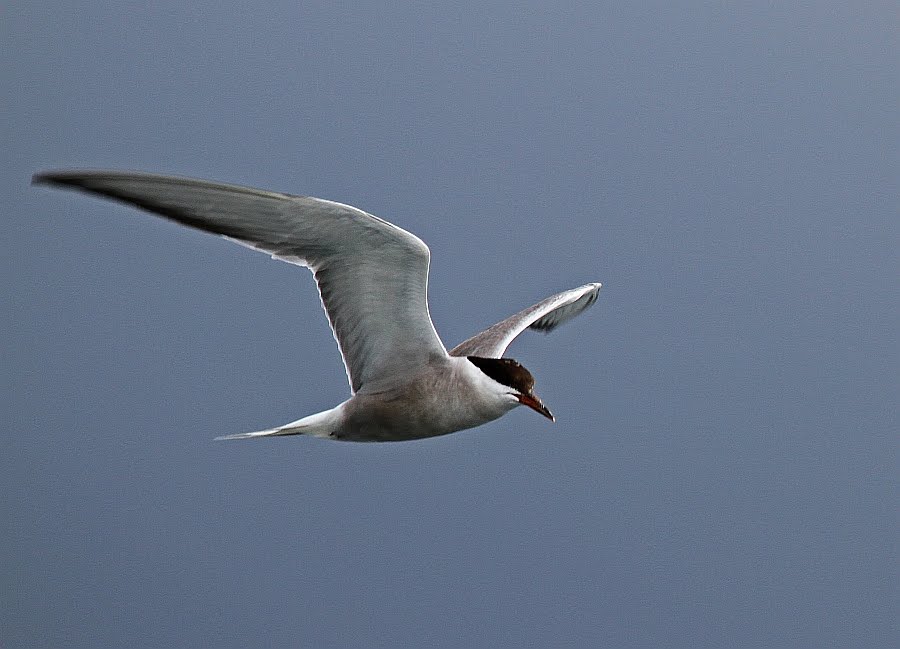
There were three Common Terns today - one of each age class. This is an adult - showing surprisingly dark underparts.


A 2nd summer...


And a 1st year bird.


The biggest surprise of the day was not one, but four jaegers! I thought that these would have long departed, but there were two first year Long-tailed Jaegers and 2 2nd yr or adult Parasitic. This is the first Long-tailed.


A second, pale-headed Long-tailed.


The first Parasitic, with tail extensions!


The second, with none.

The last jaegers of any description were seen on 10th May, so these are pretty late.

So all in all, an excellent day, with a surprising variety of birds on show for so late in the northern spring migration season.