Showing posts with label cuckoo-dove. Show all posts

Friday, June 01, 2012

26-30 May: Cameron Highlands

The idea was a few days of peaceful family holiday; the reality was that this was school holidays, when peace and Cameron Highlands are not words easily associated with one another!

A few photos from the four days away.


A couple of shots of not-so-easy-to-see Bay Woodpeckers - these were very vocal at the summit of Brinchang at dawn.


Snowy-browed Flycatchers are typical denizens of the shady mossy upper montane forest. They're completely fearless, and often the first indication of their presence is an awareness of a pair of beetling white eyebrows glowering at you from the side of the road as you walk past!
Lesser Shortwings are very common at the summit too, and come out onto the road to feed at first light.
I set up my hide at the roadside one day, and soon realized I was in the vale of the dinosaurs! First I found myself eyeball to eyeball with this juvenile Robinson's Anglehead Lizard.
 Quite a fearsome-looking beast!
 Then the Daddy dino turned up. Check out those teeth - enough to give a nasty nip!
This third one was missing the end of its tail - a subadult male I think. They all foraged a few feet in front of my hide quite amiably.
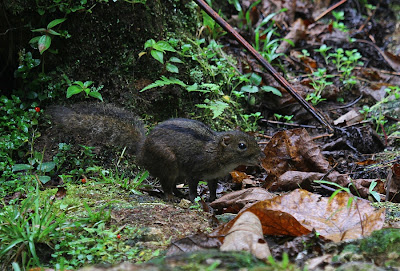
I also discovered I had parked myself near the home of a Three-striped Ground Squirrel. It provided me with regular entertainment as it darted in and out of the undergrowth collecting stuff.
 
 
Avian visitors were limited to a male Large Niltava (briefly) and a female White-tailed Robin (regularly).
Another day was spent in the hide at my favourite cuckoo-dove watering hole. Here are both species - Little on the left, a male Barred on the right.
A male Little.
And a female I think.

Male (top) and female Barred Cuckoo-doves. This is one of my favourite pigeon species - dunno why - perhaps it's because it took me so many years to see my first!
The female back-on.
Males of both species appear much larger than females, and are much bigger around the head and neck - perhaps the better to coo with!
 A female (front) and male.
The green gloss against the greys and browns of the rest of the plumage is one of the best colour combinations  I've seen in nature.


Later I moved my hide down to the stream to try to photograph the doves coming down. I wasn't successful - they were too wary I think - but I was rewarded by this juv Slaty-backed Forktail and male White-tailed Robin.

Monday, July 26, 2010

July 19-20th 2010: Fraser's Hill

About a week ago I got news from Eileen Chiang, one of our keen volunteers from the Whistling-Thrush Project, that a Malaysian Whistling-Thrush was making regular dawn appearances near the top gate at Fraser's Hill. Apparently it was an unbanded bird, so not the one we caught there last October.

As it happened, I had a job in Kuantan last week, and Fraser's Hill just happens to be a convenient mid-point to break the long drive from Penang!

Having ascertained the exact spot from Durai, I set up my hide before dawn on the 19th and waited...


Pre-dawn, this Slaty-backed Forktail fed around the foot of one of the roadside lamp posts.

Several times I heard the thrush calling, but always from behind my hide! After two hours or so I gave up.

A short visit to Hemmant's Trail provided brief views of a pair of Malayan Partridges, and I heard this pair and another on Bishop's Trail duetting. No photos this time though! Leeches were out in full force after the recent wet weather - I collected 7 on one leg on a brief foray down Bishop's Tail!


I spent much of the rest of the morning on the lower parts of the road down to Jeriau Waterfall in the hope of finding Marbled Wren-babblers or Ferruginous Partridge. I found neither, and my best bird was this Speckled Piculet. Still room to improve my shots of this species!


Just over a year ago I photographed a presumed juvenile Black Eagle near High Pines. While I was birding in the garden I heard the familiar mewing call of a a juvenile and saw this bird - perhaps one from this year's brood?


Unfortunately , though the bird was flying low overhead, the clouds were also low and the light was awful!


The light got worse. This Silver-eared Mesia shot was taken just before the rain started!


And this one was during the rain - while I was sheltering under a convenient roof!


Eventually the sun broke through again over the stunning forested valley below High Pines.


As usual, Pine Tree trail was quiet, though I did see a pair of Chestnut-crowned (aka Malayan) Laughingthrushes feeding a fledged juvenile. This parent was wearing a Wildlife Department ring.


A night drive round Telekom Loop after dinner yielded no close calling Mountain Scops-owls, but this obliging Brown Wood-owl and a Common Palm Civet.

The following morning I was again at the top gate with my hide, but this time with a Cunning and Sophisticated Plan. This time I rotated my hide 180 degrees to face the other way!

As it got brighter and brighter I wondered whether I would be frustrated again, when suddenly, just before 7am, I heard the thrush call, and very soon it alighted on the road. I was treated to a full half an hour (on and off) of the bird feeding on the road in front of me, sometimes just a few meters away! Here is a selection of photos.


Here's a short video of the bird.


Sobering to think that this site is currently the only one in the world where this species can be reliably seen.

Once the thrush show was over for the morning, I hit the trails again, and almost immediately disturbed a male Mountain Peacock-pheasant which had been feeding on the trail. I left the place alone for about an hour, then revisited it, this time flushing a female from beside the trail, and finally, managing to spot the male back in the same place as before long enough to grab a few shots.


The second shot gives a more accurate impression of the tail length. Sadly he turned his head away at that moment!


A short visit to High Pines garden in the hope of a repeat of yesterday's performance in better weather provided some consolation for the absence of the eagle in the form of a Grey-bellied Squirrel...


... and an obliging singing male Little Cuckoo-dove.

Not a bad morning's birding, all before 9.30am. Now it was time to hit the road and start the long drive to Kuantan. However, I already had plans for the return leg of the journey, to try to get better shots of the obliging pheasants.


Shrinking forest. This scene was just a few kilometers beyond Fraser's Hill on the road toward Bentong - hill forest being cleared to make way for oil palm - it's still happening...

Thursday, July 09, 2009

4th July 2009: Cameron Highlands, Malaysia

This trip was a combination of a chance to spend a few days with some old friends, meet some new friends and take advantage of an extended Selangor Bird Group stay at a timeshare apartment.

The old friends were Dr Graham and Jenny McAll, and the new ones - Peter and Miranda Harris. Peter and Miranda are the founders of A Rocha - a Christian conservation organization. There's a short video clip of their work here. I read Peter's first book , Under the Bright Wings, some years ago, and have been an admirer of A Rocha's work since. Both the Harris's and the McAlls are here on A Rocha business, holding seminars in Singapore and Kuala Lumpur on biblical environmental stewardship.

Peter is what I would call a 'dead keen birder', so it was my job to introduce him to some Malaysian montane birds while the rest of the party relaxed and enjoyed themselves. It was a tough job but someone had to do it!


We stayed at the Lutheran Bungalow, which is at the end of a very birdy lane in an area of CH I hadn't visited before. Pre-dawn this Blyth's Hawk-eagle was already on the alert.


In a wooded ravine not far from the bungalow, large numbers of cuckoo-doves were coming down to drink in a sadly polluted stream. There must have been a hundred or more Little Cuckoo-doves, and about thirty Barred - a lifer for me after many years of looking! This was my first shot - a digiscoped effort.


A couple of flight shots. Robson states that Barred Cuckoo-dove has a 'long, graduated tail with no white or grey markings', but as can be seen here, the outer tail feathers have quite obvious pale grey terminal and subterminal markings, which are lacking in Little.


Later I found a branch where many of the birds would perch en route to or from the water. It was a little dark and in the shade, but at least it gave a chance of a clear shot. Here a female Barred sits alongside a female Little, giving a good impression of relative size and bulk.


The female is well barred all the way down the underparts.


In the sun, both sexes have a gorgeous mint choc chip green sheen to the neck and upper breast feathers.


A couple of Little Cuckoo-doves on the same branch. I think the right hand bird may be a juvenile and the left one a female.


A male (right) moves into a better posing position!


Juveniles were a feature of this trip - obviously this is one of the peak breeding periods - here's one of several young Slaty-backed Forktails we saw.


"Cuckoo-dove valley" held several singing Lesser Shortwings. Here's an obliging subadult male (aged by the brown primaries).


A Lesser Racket-tailed Drongo enjoying the first rays of the morning sun. Most Lesser Racket-tails seem to be minus their rackets, but are easily identified by their square tail and wedge-shaped 'foreheadless' head.


Bar-winged Flycatcher-shrikes seem particularly numerous in the Cameron Highlands.


A composite picture of a single subadult Rufous-bellied Eagle. The underwing coverts and some of the body plumage is still juvenile. The shape of this eagle in flight is quite similar to Booted Eagle.


 A short walk along Trail 5 in the afternoon yielded a few passerines, including this moulting male Black-throated Sunbird...


... and several hyperactive Yellow-breasted Warblers - common but so difficult to get a decent picture of!


A striking leaf!


I thought a pair of Everett's White-eyes were being very obliging, hanging around close by and preening - until I realized that I was sitting a few feet from their nest - so I hastily retreated!