
It was wet! We were cut off for 24 hrs at one point, with water rising to shoulder height!

Not much yellow on the bellies of Yellow-bellied Prinias in East Malaysia! This is the endemic subspecies 'latrunculus'.

Bird diversity in oil palm is pretty poor, but around the edges it can get interesting if there is forest remaining, even where it is severely degraded. This menggaris (tualang) tree was home to a pair of nesting Changeable Hawk-eagles, and the same area had Storm's Stork, Black-and-Crimson Pitta, Chestnut-necklaced Partridge, 4 hornbills including Wrinkled, Thick-billed Flowerpecker and Blue-and-White Flycatcher.

Crimson Sunbirds occur wherever there are nectar-producing plants.

A couple of recent arrivals...Red Junglefowl has been introduced to many plantations as a pest control measure...

Little Grebes have arrived under their own steam. We found them in two estates where suitable ponds existed.

Another relatively recent immigrant - this one from the Philippines - Striated Grassbirds frequent open grassy areas and love telegraph wires to belt out their song!

Wandering Whistling-ducks, on the other hand, have wandered up from Kalimantan, and are now the commonest duck in many areas. Compared to Lesser Whistling-duck, Wandering has a blacker, more substantial bill (shoe-shaped rather than triangular), has richer, more orange tones below, and a more pronounced dark line up the back of the neck and over the crown, which 'spills ' onto the face down to about eye level, especially in the loral area.

The flank plumes are much more prominent on Wandering than on Lesser. Compare with some Lessers here.
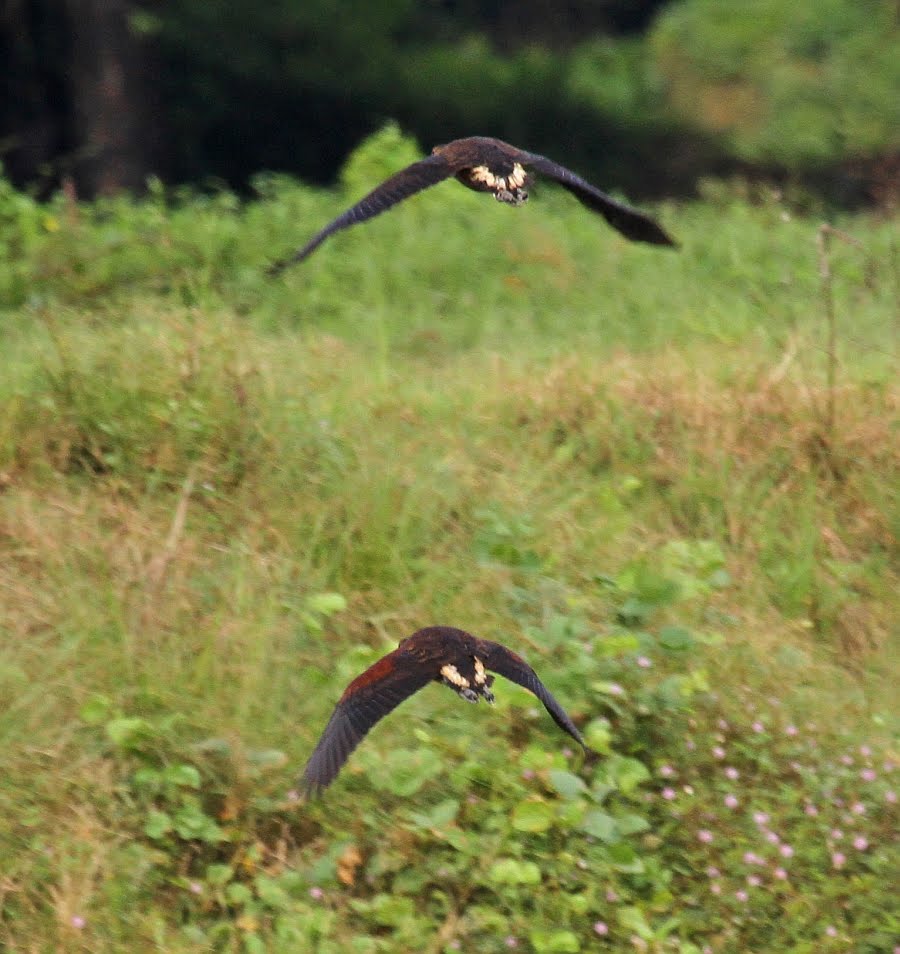
In flight, viewed from above, they have obvious whitish uppertail coverts, unlike Lesser.

From below they're a little trickier, but with a decent view, the different bill structure and flank plumes distinguish them.
The wetland areas were the most interesting. Being cut off for a day gave us chance to wander round some effluent ponds, which, despite being well inland, proved a haven for a good variety of migrant and resident waterbirds.


White-browed Crakes were everywhere!

We found just one Moorhen, which proved to be Common rather than Dusky, to our disappointment!

This juv Yellow Bittern, with its browner streaked body and lesser coverts, could be mistaken for a Schrenk's (and had me going for a moment!).

There was quite a good variety of waders in small numbers. There were about 20 Long-toed Stints...

Some Pacific Golden Plovers, including this smart bird...
There were Wood Sandpipers, Common Sandpipers, Common Greenshank, Marsh Sandpipers, Black-winged Stilts, Pintail/Swinhoe's Snipes...

A Black-tailed Godwit, looking very out of place!

And, best of all, a Red-necked Phalarope! This was a Malaysian lifer for me, and was probably there as a result of all the rough weather we'd been having.


It was typically full of energy, chasing after waterborne invertebrates.


Quite flighty too, it would make little sorties round the pond, usually returning to its original spot.


Amazingly, the commonest hirundines were these Riparia martins. There were at least 10 birds. "Sand Martin" is a rare visitor to Borneo. However, these looked just like the birds I've been seeing in the Penang area over the last few years, very little tail fork, clean white belly below a narrow breastband, tiny bill; all of which hint at the possibility that these birds may be Pale Martins. We'll work it out eventually!

Common Sandpiper footprints. It's the only wader that will routinely feed inside the plantation.

Leopard Cat seems to be the only feline which thrives in oil palm. This young animal was one of 27 we observed in four night surveys!


