Showing posts with label sunbird. Show all posts

Thursday, July 07, 2011

29 June - 4 July 2011: Poring, Sabah

Just back from a relaxing few days in Sabah, initially to do a survey of bird life around a new Jungle Camp, entrancingly called "Lupa Masa" (Forget Time), and then to spend a few days in the more familiar Poring Hot Springs park area.


The dining area. The place really blends in with its surroundings, and it is not difficult to indeed forget time there. The story of the genesis of this place can be read here. It's not long before the only clock you take notice of is the natural rhythm of the dawn-day-dusk-night.


You sleep in 'sulaps' - ingenious structures housing cozy hammocks complete with mosquito nets. From one of these some lucky visitors had wonderful views of a Yellow-throated Marten family at play.


I wasn't quite as lucky, but was fortunate enough to photograph this male Purple-naped Sunbird while laying on my sleeping-bag!


It was only a few metres away, yet completely oblivious to my presence! Very nice!


Not a bad place to cool off after a hot day in the jungle! Complete with fish which nibble your toes, and the occasional Bornean Forktails and Bornean Whistling-thrush.


The endemic Yellow-rumped Flowerpecker was a common visitor to the dining room verandah.


Black-winged Flycatcher-shrikes were also seen there daily.


If you visit the camp, look out for this fellow - I think he's wanted for rustling!


Lupa Masa offers some exciting possibilities for exploring the quieter areas behind the national park. I spent the last few days of my stay in the park proper, trekking up to the spectacular Langanan Waterfall.

You can't go to a place called "Poring' and expect not to get wet, it is RAINforest after all! The rain was fairly predictable, however, usually arriving around midday or early afternoon, giving me clear mornings.


On my first day I decided to reacquaint myself with one of the Park's more well-known residents - Blue-banded Pitta.


This was a markedly brighter bird than the one I photographed at Kubah in Sarawak - too bad I didn't quite get the same photographic opportunities!


The red on this bird is far more intense and 'pure' than on the Kubah bird, and the blue chest-band is broader (cf these pics and these.

I spent a lot of time on the trails hoping for a shot of Bornean Banded Pitta, but a single call was the closest I got for my efforts!


I was pleased to get a look at the Bornean melanops race of Banded Kingfisher. This one was wrestling with a large stick insect. As I watched, it flew to another branch where a juvenile was waiting quietly.


Too bad my camera's autofocus popped out at the critical moment, but I was interested to see that the fledglings are sexually dimorphic - this one is clearly a male.


A bit late now, but a sharp shot at last!


Another juv Banded,another endemic subspecies (brookei), but a Broadbill rather than a kingfisher - rather overflashed! This and Black-and-Yellow were my only broadbills of the trip. Despite much searching, the Hose's remained elusive.


A few non-avian images. The second butterly was huge, and in flight had exactly the colour scheme of a White-crowned Shama (and it was nearly as big!).


Some friendly frogs!


A Plain Pygmy-squirrel...


...which was not only cute...


...but also fascinating! As it moved around it constantly rotated the rear of its body to rub itself against the bark of the vine - whether to scent-mark, alleviate some itch, or for another reason I couldn't tell.


OK, so sometimes I was bored!


This Grey-headed Canary-Flycatcher seemed to be permanently stationed on this particular dead branch at all times of day and every day. This enabled me to try out every possible variation of ISO, flash setting and shutter speed, and still only come up with a rather mediocre series of photos! I'm hoping one day someone will help me understand how to use flash properly!

I'll finish off with two hard-to-photograph species:


Olive-backed Woodpecker (juv?) male.


Female.


And a rather fine White-necked Babbler.

Thursday, June 02, 2011

19 - 21 May, Batu-batu Resort, Pulau Tengah, Johore

I was invited to visit this new resort on Pulau Tengah as part of a team who are putting together a new exciting project - BRISC for short, or Batu-batu Reef and Island Study Centre for long! Take a look here for how the resort is taking shape.


The three most obvious 'tracks' for BRISC are 1) the reefs and corals, 2) turtles, and 3) birds. The latter is where I came in! Though the island is quite small, about 2 square km, it is strategically situated in the South China Sea, and I expect that it will prove to be a magnet for migrating birds, especially in the southward migration season (Sep - Nov), as well as a good jumping off point for pelagic forays for seabirds.

Here are a few pics from my three days of heaven-on-earth!


Boy - this was a tough assignment!


But someone had to do it!


Here's the view from my room.


At one end of the island there's a rockpool 'garden' at low tide. I'm no good at marine stuff, but here are a few things I found in the pools:


An anemone ... sounds like the beginning of a tongue-twister!


Another kind of coral.

Some fishies...


Big fish, small fish, blue fish, fat fish... now I sound like a Dr Seuss book!


This is a Ghost Crab I think.


And this very cool creature looks like a clam.


Native bird life on the island is quite sparse, but a fruiting fig near the chalets was a hive of activity each morning. This is a female Brown-throated Sunbird.


Undisputed stars of the show each morning were a flock of Pied Imperial Pigeons. There's no known sexual dimorphism, but there were two distinct plumage 'types', as can be seen here. Wells notes that "the white parts of fresh-plumaged adults are flushed ivory-cream, perhaps by preening from lipid-producing feathers". So maybe the ivory-white birds were subadults.


It was the creamy birds which most drew my attention. In the golden early morning light, they were truly stunning creatures!


It was the ripe, pink figs they were after!


I was amazed at how broad the bill is - obviously tailor-made for walloping fruits in one gulp!


Down the hatch and after another!


The light filtering through the wings made it look as if the bird had golden underwings!


Another fig swiftly dispatched!


The unexpectedly gorgeous Pied Imperial Pigeon!


A couple of flight shots showing the distinctive wing and tail pattern.


A few Pink-necked Green-pigeons crashed the party. They didn't have a big enough beak to swallow the fruits whole, so things got a little messy - and each sported a bright pink forehead as a result of staining from the fig juices.


But it blended right in with the rest of their colour scheme!


Pacific Reef-egrets are among many species which island-hop.


We took a small boat out one day to prospect some of the smaller islets in the archipelago. Plenty had Black-naped Terns on them.


The bird with the smudgy mask and grey spots on the wingtips is a one-year old bird. The others are adults.


They're iconic birds in flight!


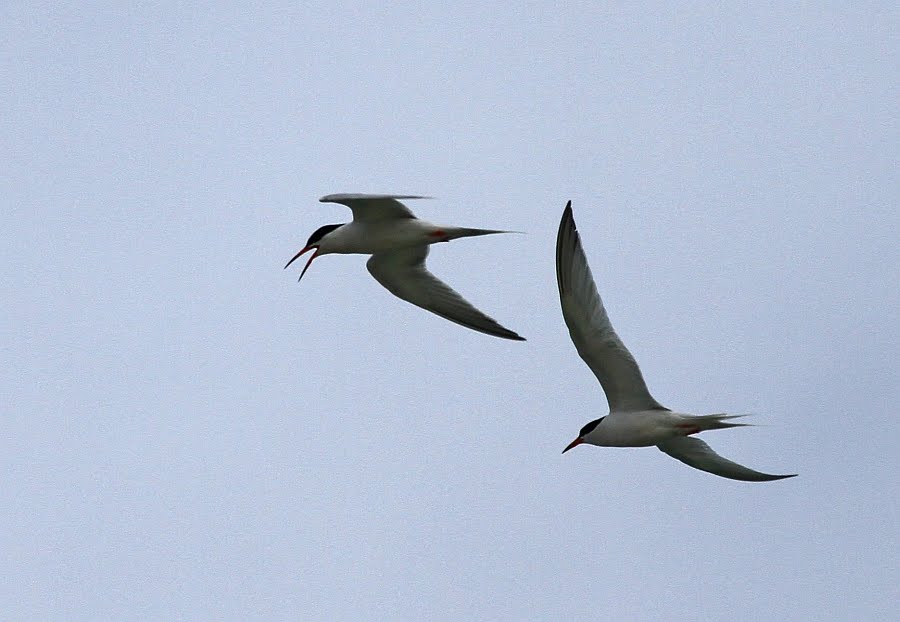
I was hoping to find some Roseate Terns, and eventually we had brief views of a pair which flew overhead, mobbing the Black-naped.


I was surprised at how much red was on the bill, compared with an adult we saw recently on the west coast. I suppose it must be a feature of birds in breeding condition.


A sea cave on one of the nearby islands.


A yellow Chinese lantern moon.With so little artificial light, the island would be a great place to star-gaze.

For more information on BRISC and Batu-batu resort, see the website and Facebook page. As well as a full-time Divemaster, we're looking for volunteers to a) monitor bird migration on the island and b)conduct pelagic seabird surveys on board local fishing vessels this autumn, from September - November. If you'd be interested in being a volunteer for part or all of this time, please email me!


The beach at Mersing still had a decent flock of non-breeding waders - mostly sand plovers and Terek sandpipers, but with a few Ruddy Turnstones and a single Red-necked Stint which you should be able to spot in the flight shot.