Showing posts with label snake. Show all posts

Tuesday, October 26, 2010

19th October 2010: Danum Valley Borneo Rainforest Lodge

A few pics from last night's night drive to start with...


A Black Flying Squirrel


And a Slow Loris performing a comical stretch!


It was worth checking the spiderhunters coming to the Indian Coral tree this morning. Yesterday's were Spectacled. Today there was Yellow-eared.


We headed back to where we'd heard the Giant Pitta yesterday, but it wasn't interested today. After some time of Wang Kong's best imitations, we gave up and headed elsewhere. This Great-billed Heron looked 'atmospheric' in the morning light.


A Purple-naped Sunbird stopped long enough to be snapped.


It's difficult to give an impression of how small pygmy squirrels are from a photo, but they really are tiny! This is a Plain Pygmy Squirrel.


We photographed this anglehead lizard - Gonocephalus bornensis - while waiting for a Black-throated Wren-babbler to show itself. It did, but not well enough for a photo!


Chestnut-necklaced Partridges seemed quite common once they started their loud duets. Getting a clear shot was another matter, as they were shy.


On our way back for lunch we came across this beautiful Common Bronzeback.


We met Glenda, Maye and Eileen from MNS HQ, and they showed us a pair of Maroon-breasted Philentomas. Here's the male.


Displaying to the female.


The view from my chalet after lunch, before the skies went grey!


A Rufous-tailed Tailorbird near the restaurant.

The rainclouds gathered and the thunder rolled, but the rain didn't arrive, so we set out for our afternoon session up the main access track. We hadn't gone very long when a Giant Pitta started calling from the forest to our left. Seven of us (including two guides) made our way none too silently into the undergrowth and tried to call the bird into view. After some minutes of frustration, Wang Kong decided we should make our way uphill till we met the trail. We had circled the point where the pitta had been calling, and were now above it. However, I seriously doubted the bird would still be interested after all the noise we had made moving uphill.

To my surprise, it did respond to Wang Kong's whistled imitation, and after some time, the bird - a male, hopped onto the trail and perched motionless in full view for 20 glorious seconds! It was a bit too far away for my flash to reach, but who cares - the mythical Giant Pitta has been well and truly grilled!


The Holy Grail of the Malaysian rainforest? Well, one of them!

I don't remember much after that1 I think we turned round and headed straight back to the resort without lifting our bins to look at another bird!


Oh yes, and we saw a Thomas's Flying Squirrel on the night drive.

Sunday, August 01, 2010

24th July 2010: Fraser's Hill

As soon as the workshop in Kuantan was done I hit the road - at about 6pm on Friday evening. I was determined to make it to Fraser's Hill in order to be in my hide the following morning to try to get better pictures of the peacock-pheasant! About 5 hours later I rolled up at the Puncak Inn to collect my keys, feeling like a zombie and just thankful I had made it without driving the car off the road!

By 6.30am the following morning I was installed in my hide where I'd seen the male pheasant twice on the 20th. However, due my extreme fatigue I was battling a migraine, and I gave up after a couple of hours, having seen nothing.


On my way back to the car I found a Mountain Imperial Pigeon sitting on a fairly low perch.

While I was watching it it suddenly slipped off the perch and dived for cover. Looking up, I saw a Black Eagle skimming the tops of the trees!

Unfortunately for photography, the clouds were low and rain was imminent - in fact it started to fall while I was watching.


Excuse the weird colours - I've had to lighten the images up quite a bit to get any detail on the underside of the bird at all!


As Terence commented on a previous post, this bird looks older than a juvenile. In fact it seems to have begun primary moult, with the three innermost looking fresh and the outer 7 quite worn. So perhaps it's last year's or even a third-year bird. Note the epiphyte it is sitting on at the top of the pine tree.


While I was photographing the bird perched on the pine tree, it started looking up and I was surprised to see a second bird approach and knock the first one off its perch!


The new bird was also a subadult, but was clearly larger than the first, making it a female, the smaller bird being a male.


It wasn't easy to tell them apart unless a direct size comparison could be made.


Which it could sometimes!


Note that the female has grabbed a chunk of the epiphyte from the pine tree. I noted this behaviour by a juvenile last year, when it was suggested that the observation might refer to the bird having robbed a nest. These photos show otherwise. The bird has ripped off a chunk of epiphyte from the tree and appears to be carrying it 'for the fun of it', or maybe to practice seizing and carrying prey?


There was quite a bit of sparring between the two birds.


Eventually, I had to walk away from the two birds and head for something to eat, followed by a few hours sleep!


A few photos from the afternoon - this female Black-and-crimson Oriole had found the most enormous caterpillar, and was roundly smashing it against a branch. Unfortunately she flew off before I could see how she would go about swallowing it!


I spent some time at the Glossy Swiftlet breeding colony in the garage on Telekom Loop trying to get flight shots. These were my best attempts.


A photogenic male Grey-chinned Minivet.


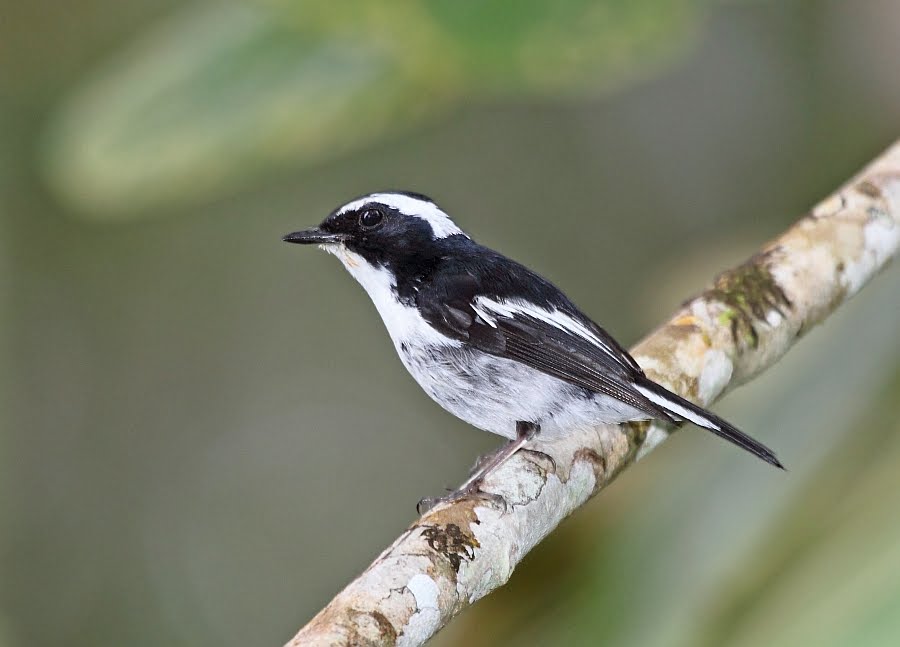
Little Pied Flycatchers are common but always good to see!


I came across this juvenile snake, which I believe is a Speckle-bellied Keelback. Please let me know if I'm wrong!

On Bishop's Trail I had the good fortune to see two Rusty-naped Pittas. They were two males, and they were chasing each other in an apparently territorial dispute. I was surprised to see that they perched on low vines as well as on the ground. No photos unfortunately. This is the first time I have actually set eyes on this species at Fraser's Hill in 22 years! I saw a Malaysian Partridge also along the same trail, but briefly!


My final shot of the day was this female White-thighed Surili with her baby. Now I know where the idea for the Teletubbies came from!

Wednesday, April 07, 2010

29th March 2010: Lower Kinabatangan River, Sabah

I was hoping for some blue skies to get better shots of hornbills today, but the early signs were not promising!


KJC in the pre-dawn murk


The dining area, waiting for breakfast!


The river at dawn.


Front to back, Dieter and Alicia Kamm, a birding couple from Arizona, Robert Chong, and our expert driver. Our main targets for the trip were Bornean Ground Cuckoo and Giant Pitta, and other possible lifers for me were Great-billed Heron, Jerdon's Baza and White-fronted Falconet.


Heading into Ground-cuckoo territory, the weather did not look promising!


But the sun began to burn off the early morning mist, and things began looking up weatherwise.


It's not just bird photographers who use hides - birds use them too! This Blue-eared Kingfisher appeared to be camouflaging itself behind these three leaves.


The orange lower mandible marks this bird as a female.


Here's a male.


A Malaysian Blue Flycatcher of the endemic race 'turcosus'. Surprisingly, this bright-plumaged bird is a female.


Males have a blue throat. These flycatchers and the kingfishers are the standard common birds of the riverbanks here.


We watched nine Rhinoceros Hornbills follow each other across the river. From the development of their casques, they all looked like subadult birds. Here's the first, a male (red iris)


Next was a young female (whitish iris)


Number three was a more mature? female (white iris)


I guess this could have been an adult female, as the iris is brilliant white, but the casque doesn't curl backwards at the tip.


Number 5 was a young male


Number 6, another male


Another female.


And number 8, another female. Somewhere in the excitement I forgot to photograph number 9!


A juvenile Oriental Pied. I seemed to have timed my visit to coincide with the end of a breeding cycle


Oriental Darters are quite common but also very shy and difficult to get close to

Forest birds in general were exceptionally quiet - we only heard one pitta - a Hooded briefly, and there was not a squeak out of the ground-cuckoos.


As we headed upriver for lunch, several Storm's Storks and Lesser Adjutants (pic) could be seen thermalling high in the sky.


Back at the camp, butterflies swarmed over any patch of dampness. Walking through them, we were enveloped by clouds of living confetti!


If you come to Malaysia as a tourist, it's a good idea to learn some basic Bahasa Malaysia, the national language. Here's a useful little sign. Let me give you a quick language lesson.

"Awas" means "Beware!"

"Berhati-hati" means "Be careful!"

Getting the message?

"Sungai" is river, so "Sungai ini ada buaya" means "This river has buaya."


This is a buaya! A big buaya!


And this is why it's a good idea to learn the meaning of "Awas" and "Berhati-hati"! We witnessed an almost fatal and shockingly fast attempted ambush of a Long-tailed Macaque which had strayed too close to the river bank. One moment there was just a monkey taking a drink, the next the water erupted and the monkeys leapt back with much shrieking. The attack was too fast for our eyes to see the outcome, but afterwards a lack of blood in the water showed that the macaque had lived to tell the tale. Perhaps it should learn to read.


Birdwise the afternoon was even quieter than the morning. A male Black Hornbill was one of few highlights.


Followed a little later by a female.


We were lucky to get close views of this Lesser Fish Eagle. These were generally shy, keeping well ahead of our boat. I think this one had been disturbed by another boat further downstream.


A resting Mangrove Snake, which I think is also known as Yellow-banded Cat Snake.

At this point we even began to try to photograph the Slender-billed Crows, but the light was too bad to get any decent shots. On our way back to camp we got brief views of a medium-sized raptor carrying prey which flew across the river and disappeared into the forest. At the time we dismissed it as a Crested Goshawk, but my blurry photos suggest it was more likely to have been a Jerdon's Baza. Oh well!


No sign of Elizabeth the badger after dinner, but we were entertained by another regular customer - Tom the Malaysian Civet.