Showing posts with label falconet. Show all posts

Sunday, October 24, 2010

15th October 2010: Borneo Bird Festival, Sepilok, Sabah

Today was the start of the Festival and RDC was a hive of activity...


The unveiling of the Borneo Bird Club logo.The BoBC has just become an officially registered society, so is now well and truly open for business. Kudos to Cede Prudente, the pro tem Chairman, and his band of merry (and hard-working!) men and women for having achieved so much in the club's young life.


The BoBC stand, and some serious Big Boys Toys on show!


The launch of the Bird Race, just before the heavens opened and everyone ran for cover!

Apart from attending the formalities, I had no other responsibilities today, so plenty of time for birding!


Our first good find of the day was a pair of Slow Lorises and a baby, apparently happily feeding at ten in the morning!

Some more bird images from my walks around the Rainforest Discovery Centre today


Banded Woodpecker


A Blue-eared Kingfisher (I didn't see the Ruddy Kingfisher which everyone else photographed by the way!)


I'm not quite sure what this is! If it was in West Malaysia I'd have called it a Crow-billed Drongo without a second thought, but in East Malaysia the Greater Racket-tailed Drongos are heavy-billed, lack much of a crest, and have a deeper tail fork than the West Malaysia birds. I'm not familiar enough with East Malaysian GRTs to feel confident that this is or isn't one. The fact that the bird is in tail moult doesn't help - as it's difficult to be sure what the tail shape would look like in fresh plumage. Compare with this pic of a Greater Racket-tailed I shot in Kubah recently. Any ideas?


A distant White-fronted Falconet, endemic to northern Borneo.


A small party of Rufous-winged Philentomas foraging just above the ground along the Pitta Trail was the highlight.


Perhaps it was a family group - there was one adult male and several female/juvs.

Back at the Nature Resort, the fig festival was still in full swing!


A female Black Hornbill - one of the regular crowd.


And the female of the neighbourhood Rhino family.


Streaked Bulbuls are always good to see.


Puff-backed even more so - a shame that this was such a mangy individual.


When a flock of Asian Glossy Starlings flew in I started looking for some Chestnut-cheeked, and was soon rewarded! This female/juv could easily be overlooked among Purple-backed Starlings if it was in Peninsular Malaysia. Note that it lacks the whitish lower scapulars and pale greater covert tips of Purple-backed, and is generally browner.


Males are easier to spot. This one has more extensive 'chestnut cheeks' than any illustration I've seen!

My second new bird in two days, and both in the same tree!

Wednesday, April 07, 2010

30th March 2010: Lower Kinabatangan, Gomantong Caves and Sepilok

Our last morning at KJC was spent on another excursion to look for the ground-cuckoo.


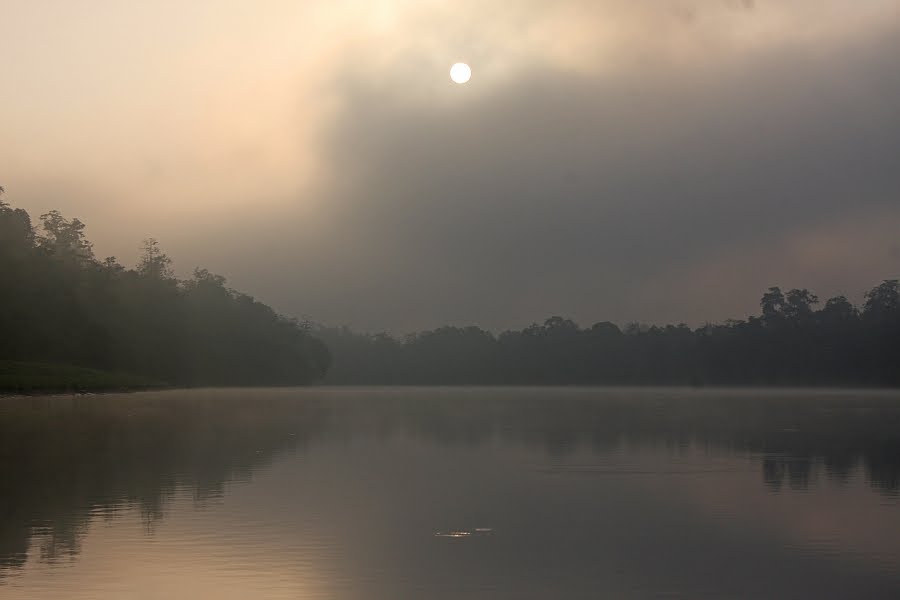
The river just after sunrise.


One of our first birds was this Storm's Stork feeding rather close to the water's edge.


It flew up into a nearby tree at our approach, so we probably saved it from being a croc's breakfast!


Have a guess what this is!


Taking a morning bath at speed!


Did you guess right? A pair of Brown-backed Needletails came down to bathe near our boat. This stunning performance was one of the highlights of my whole trip. Sadly neither the camera nor the photographer were quite up to doing the whole experience justice!


Turning up the creek to look for ground-cuckoos, I finally got a shot of an Oriental Pied Hornbill in good light. This is a male.


Wood Nymph butterflies have a unique slow fluttering wing action. This one went right over us!


Black-naped Monarchs are commonly heard, but less easy to see well. This male had just had a dip in the river and was finishing off his morning ablutions.


We came to a log that had fallen across the creek, effectively turning it into a cul de sac. This Oriental Darter found itself caught between us and the fallen tree, and wasn't quite sure what to do, enabling us to get great views of it.


The tertials and tail feathers are quite extraordinary. They look as if they're made from PVC rather than feathers!


Eventually the bird had to move, so it opted to fly as far as the fallen log.


It then sank out of sight like a submarine diving, only to appear from the neck up near the bank, trying to look inconspicuous.


Finally, it decided to make a dash for freedom, so with much flapping and splashing, it took off and flew past us. Fantastic!


Meanwhile on the fallen tree itself, a troop of Pig-tailed Macaques were sunning themselves. These youngsters were busily quarrelling, quite oblivious to us.


They made friends again later!


I started to feel guilty under this one's reproving stare!


I decided this one must be a teenager!


On our way back we came across this female Rufous-tailed Shama carrying food. Robert told us that this is a rare bird here - more rarely seen than the ground-cuckoo in fact...! This was not much consolation for the continuing silence from the cuckoos.

We had brief views of Scarlet-rumped Trogon and a Hooded Pitta, but otherwise, the birds were much the same as yesterday, until...


...Robert pointed out a couple of White-fronted Falconets - two males. My first lifer since arriving in Sabah!


Fairly high up, but that's quite typical of falconets I guess!

Oh well, plenty to come back for, which I certainly plan to. The Lower Kinabatangan is one amazing place!

En route back to Sepilok, we stopped to look at a few birds...


...a Striated Grassbird


...and several Bat Hawks. Bat Hawks were about the most frequently encountered raptor on my trip. I counted 7 birds between Kinabatangan and Sepilok. Every mengaris (tualang) tree seemed to have at least one bird, even if the tree was the only one standing in a sea of oil palm.


We stopped off at Gomantong Caves so that we could tick off Edible-nest, Black-nest and Mossy-nest Swiftlets (pic), which can all be safely identified as they sit on their distinctive nests. The rain made the steps in the cave treacherously slippery, and the handrails were not much help, being covered in guano and crawling with cockroaches. The stench of ammonia from the guano in the cave was pretty powerful.

Also en route back to Sepilok, we stopped and scanned a weedy pool in an oil palm estate. It only had five Common Moorhens and a Little Grebe on it, so we didn't spend much time there. It was only when we reached Sepilok and I checked Myers that I realized that there are only a small handful of records of Little Grebe from the whole of Borneo, and that it was undoubtedly the rarest bird of the trip!


Back at Sepilok just before dusk, we made for the Bristlehead Tower again. I got another chance to photograph the male Scarlet-backed Flowerpecker, and another chance to miss Bristlehead! The flying squirrels weren't in the mood tonight either - only a couple appeared long after dark.


After dinner we went out to try for night mammals and birds. Our success was limited - a few Brown Hawk-owls, this Colugo...


...and a roosting Black-backed Kingfisher, looking like a gem in the spotlight!

So, four mornings and four evenings at Sepilok produced no Bristleheads, three days at KJC produced no ground-cuckoos, and in the whole trip I only saw one new bird! Nevertheless I was well-pleased with this trip, and it gives me a good excuse to go back again!