Showing posts with label darter. Show all posts

Tuesday, January 03, 2012

28 December 2011: Batu Kawan and Pulau Burung, Penang

Two days after we arrived back from holidays in the UK, a small window of opportunity became available, and there was only one place to go; Batu Kawan, to see whether Mun's superstar visitors had waited for me, as he had promised they would! Getting up early wasn't a problem, courtesy of jetlag, so I was on site as first light dawned.


Sure enough, a quick scan soon located a solitary Oriental Darter roosting in a dead tree, and not long afterwards, the second bird flew in, having apparently been fishing in the floodwater beneath the tree.


As the light improved, I was joined by Mun himself, so was able to congratulate him personally on a memorable find (his finder's account is here).

Having had a good look at the darters, I decided to make my way to Pulau Burung. Mun was a bit shocked when I announced that I was moving on so soon, and in retrospect, I probably should have hung around longer, as his superb shots testify, but it was my first time out in over a month, I only had a few hours, and was anxious to get better views of the Garganeys, and whatever else may be lurking at Pulau Burung.

My first port of call was the temporary pools where the Little Stints had been last time. Since then, there've been White Wagtail and Pectoral Sandpiper, so I gave it a good grilling. There were now fewer birds, and all were were much more distant. Just one Little Stint was in evidence, and no rare wagtails or waders!


As I drove along the track I disturbed a pair of foraging Barred Buttonquails. This is quite a familiar scenario. The birds run along the track directly in front of the car. They are wondering how they can escape into the foliage either side, while I am wondering how to avoid the windscreen, get my eye to the viewfinder out of the side window (pointing forwards!) while keeping my foot gently on the gas and the car from meandering off the road! As usual, I largely failed, but the male did dither long enough for me to get one or two acceptable shots.


Next up it was time to focus my attention on the Garganeys. Oddly, they didn't associate with each other the whole time I was there. This rather bright bird turned out to be a female (you can check out the forewing colour in Mun's blog here.)


The male (told by the bright blue-grey forewing) kept much more distant, and hung out with the Lesser Whistling-ducks most of the time.

The other birds present were the 'usual suspects', but, even though I have filled my memory cards many times over with their images, it's hard to resist them when they pose so beautifully!


Blue-tailed Bee-eater.


A subadult (and subtly colourful) Common Moorhen.


Common Sandpiper (and friend!).


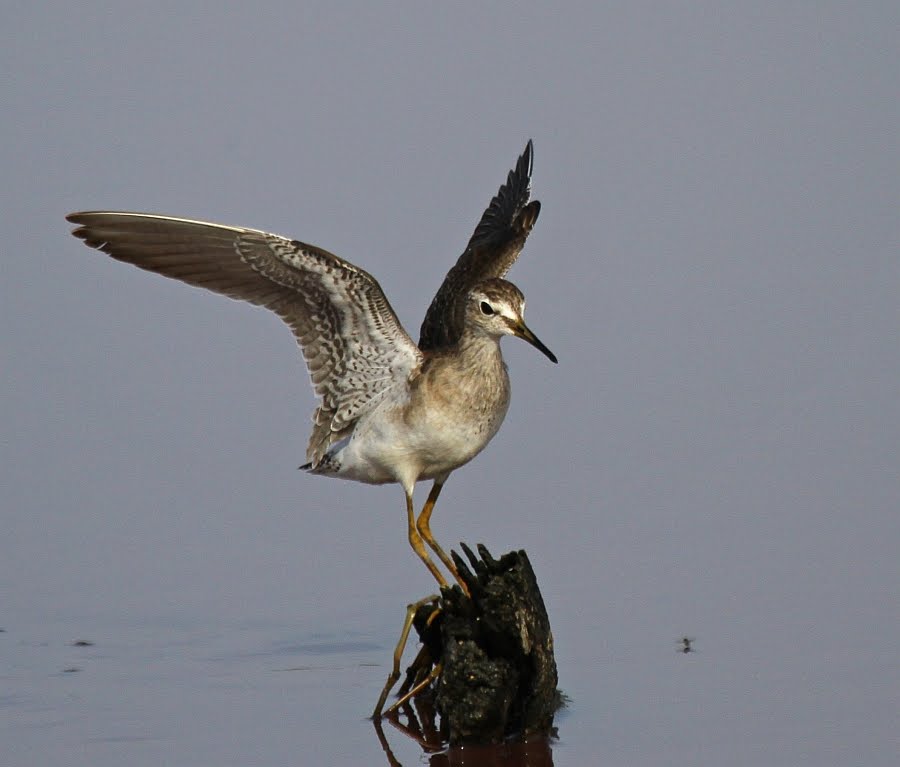
Wood Sandpipers.

So, thanks to Mun and those Oriental Darters, I managed to pick up my 560th species in Peninsular Malaysia on my last birding outing of the year! What surprises will 2012 turn up? Bring it on!

Every best wish for 2012.

Wednesday, December 22, 2010

Cormorants and Australian Darter

Mainland Australia has five cormorants, four of which are pretty widespread.


Here are three of them: Little Black, Great and Pied


The same three airborne.


This is the fourth widespread spcies - Little Pied.


The fifth, Black-faced Cormorant, is restricted to the south eastern corner.


Not a raptor ... an Australian Darter!


Wednesday, April 07, 2010

30th March 2010: Lower Kinabatangan, Gomantong Caves and Sepilok

Our last morning at KJC was spent on another excursion to look for the ground-cuckoo.


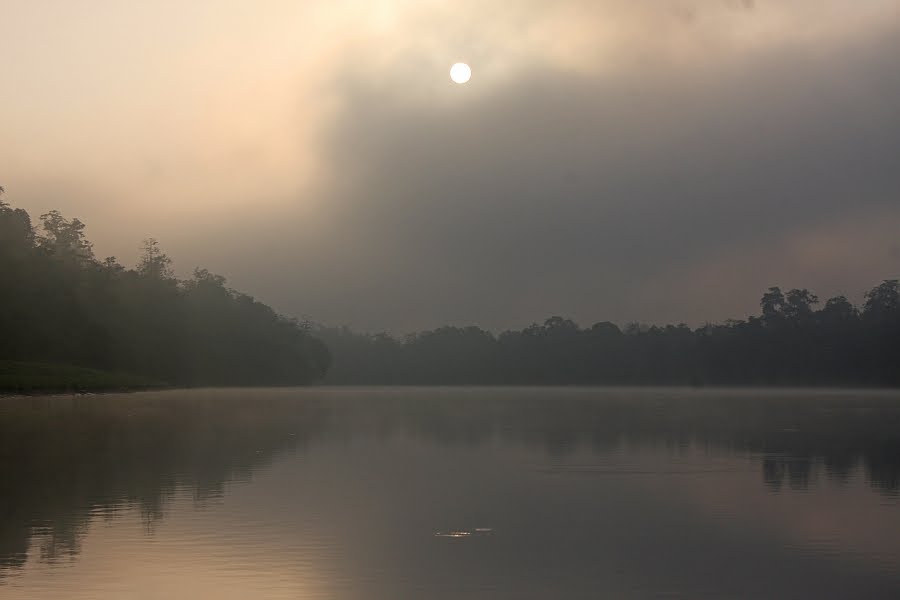
The river just after sunrise.


One of our first birds was this Storm's Stork feeding rather close to the water's edge.


It flew up into a nearby tree at our approach, so we probably saved it from being a croc's breakfast!


Have a guess what this is!


Taking a morning bath at speed!


Did you guess right? A pair of Brown-backed Needletails came down to bathe near our boat. This stunning performance was one of the highlights of my whole trip. Sadly neither the camera nor the photographer were quite up to doing the whole experience justice!


Turning up the creek to look for ground-cuckoos, I finally got a shot of an Oriental Pied Hornbill in good light. This is a male.


Wood Nymph butterflies have a unique slow fluttering wing action. This one went right over us!


Black-naped Monarchs are commonly heard, but less easy to see well. This male had just had a dip in the river and was finishing off his morning ablutions.


We came to a log that had fallen across the creek, effectively turning it into a cul de sac. This Oriental Darter found itself caught between us and the fallen tree, and wasn't quite sure what to do, enabling us to get great views of it.


The tertials and tail feathers are quite extraordinary. They look as if they're made from PVC rather than feathers!


Eventually the bird had to move, so it opted to fly as far as the fallen log.


It then sank out of sight like a submarine diving, only to appear from the neck up near the bank, trying to look inconspicuous.


Finally, it decided to make a dash for freedom, so with much flapping and splashing, it took off and flew past us. Fantastic!


Meanwhile on the fallen tree itself, a troop of Pig-tailed Macaques were sunning themselves. These youngsters were busily quarrelling, quite oblivious to us.


They made friends again later!


I started to feel guilty under this one's reproving stare!


I decided this one must be a teenager!


On our way back we came across this female Rufous-tailed Shama carrying food. Robert told us that this is a rare bird here - more rarely seen than the ground-cuckoo in fact...! This was not much consolation for the continuing silence from the cuckoos.

We had brief views of Scarlet-rumped Trogon and a Hooded Pitta, but otherwise, the birds were much the same as yesterday, until...


...Robert pointed out a couple of White-fronted Falconets - two males. My first lifer since arriving in Sabah!


Fairly high up, but that's quite typical of falconets I guess!

Oh well, plenty to come back for, which I certainly plan to. The Lower Kinabatangan is one amazing place!

En route back to Sepilok, we stopped to look at a few birds...


...a Striated Grassbird


...and several Bat Hawks. Bat Hawks were about the most frequently encountered raptor on my trip. I counted 7 birds between Kinabatangan and Sepilok. Every mengaris (tualang) tree seemed to have at least one bird, even if the tree was the only one standing in a sea of oil palm.


We stopped off at Gomantong Caves so that we could tick off Edible-nest, Black-nest and Mossy-nest Swiftlets (pic), which can all be safely identified as they sit on their distinctive nests. The rain made the steps in the cave treacherously slippery, and the handrails were not much help, being covered in guano and crawling with cockroaches. The stench of ammonia from the guano in the cave was pretty powerful.

Also en route back to Sepilok, we stopped and scanned a weedy pool in an oil palm estate. It only had five Common Moorhens and a Little Grebe on it, so we didn't spend much time there. It was only when we reached Sepilok and I checked Myers that I realized that there are only a small handful of records of Little Grebe from the whole of Borneo, and that it was undoubtedly the rarest bird of the trip!


Back at Sepilok just before dusk, we made for the Bristlehead Tower again. I got another chance to photograph the male Scarlet-backed Flowerpecker, and another chance to miss Bristlehead! The flying squirrels weren't in the mood tonight either - only a couple appeared long after dark.


After dinner we went out to try for night mammals and birds. Our success was limited - a few Brown Hawk-owls, this Colugo...


...and a roosting Black-backed Kingfisher, looking like a gem in the spotlight!

So, four mornings and four evenings at Sepilok produced no Bristleheads, three days at KJC produced no ground-cuckoos, and in the whole trip I only saw one new bird! Nevertheless I was well-pleased with this trip, and it gives me a good excuse to go back again!