My annual pilgrimage to Kapar Power Station ashponds was a couple of weeks earlier than usual due to work commitments and tides, and this time I was accompanied by 5 keen members of the Nature Society (Singapore) who wanted a baptism of fire after attending the Advanced Wader Workshop there last autumn (come to think of it, I never did do a blog post on that, did I? I must get around to it!).
My favourite wader venue on the planet never disappoints, and after three days, we were left reeling with the abundance and variety of waders on show, many in stunning breeding colours.
I've already blogged several times on identification of the various species on offer, so if you're interested in getting a refresher, I refer you to those earlier posts (click 'Kapar' in the label cloud on the right).
Our first evening was spent working out where the waders were - there are usually several roosts in the ashpond complex and they tend to move from year to year dependent on water levels and other factors. It gave us useful practice in identifying waders at a distance!
 Waders at roosts tend to group themselves into same/similar species flocks, so here the knots are in front, the Whimbrels at the far back, and the godwits in between. We spent a bit of time picking out a lone Black-tailed among the Bar-tails - can you find it (right click on the image and then left click 'Open link in new tab' to see a larger version)? (See Answer 1 below)
 Telling godwits apart in flight can be rather easier than finding them on the deck; the black-bordered gleaming white underwing and black tail makes the Black-tailed Godwit at the top (right of centre) stand out even at this distance.
 The next morning, having worked out the best place to watch from, we were in place before dawn. Roosting birds are always more vocal in the dark than in daytime, and it's always interesting to work out what's out there before you can see them! We were surprised to hear large numbers of Terek Sandpipers and Common Redshanks pre-dawn both days - by the time the sun rose, almost none remained. On the other hand, the Gull-billed Terns only arrived well after the sun was up, perhaps having slept overnight at sea? In this picture, the smaller waders are just blurred shapes as they fed busily in the foreground. Behind these are Bar-tailed Godwits and Whimbrels, and, in the further distance, a large flock of Eurasian Curlew.
 I can't think of many places I'd rather be at dawn at the end of March!
 An early scan in the gloaming picked out this leg-flagged Bar-tailed Godwit. The combination of white over black (Shanghai, China) was replaced in April 2006 by black over white, making this bird at least 6 years old.
 The same bird later in the morning, closer, but also in deeper water.This was the only leg-flagged godwit we found (among 3,500 Bar-tails and 400 Black-tails), but we had better luck with the Great Knots (next post).
 Bar-tailed Godwits (3,500), Great Knots (3,700) and Whimbrels (1,450) were among the most numerous species.
 Early morning Barwits - those rich burgundy underparts in the warm dawn light make them irresistible for photography!
 They're still pretty irresistible in full sunlight!
I've said it before, but it bears repeating that godwits are generally among the easier of shorebirds to sex, and Bar-tails especially. Note the compact lines and relatively short and tapered bill of this male, compared to the much larger, more bulky, and thicker and longer-billed female below.

Later on the flock started to bathe, and the light was good enough to capture some of the rapid movements even with the digiscoping set-up.


There's a video of this
here. Later on, when the birds flew around a bit, I was reminded of what I discovered with 'baueri' Bar-tails in Australia (and which is also true of these 'menzbieri' Bar-tails here), that many aren't 'bar-tailed' at all - more brown-tailed!
 Some more Barwits in flight, but what about the four smaller waders with white underwings? (See Answer 2 below).
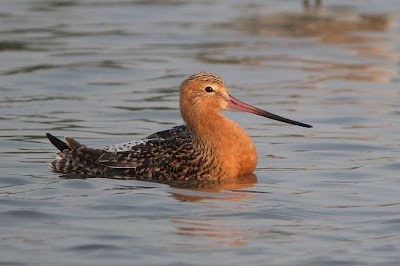
 Black-tailed Godwits were relatively scarce (we found a larger roost of these elsewhere). This taxon - 'melanuroides' (considered a full species - Eastern or Asiatic Black-tailed Godwit - by some) is usually clearly smaller than Bar-tailed - males are not much larger than Great Knots. The longer tibia, rounder head, more prominent supercilium in front of the eye, straighter bill and, in breeding plumage, tiger stripes on the flanks and breast, further distinguish it from Bar-tailed.
 This shot gives a good comparison of the differences in head and bill shape.
 This likely female is almost as big as the male Bar-tailed on the right.
Take a careful look at the pattern of mantle, scapulars and wing coverts of the Bar-tailed (left) and Black-tailed here...
 ... then see if you can work out which is which in this pic! (See Answer 3).
 In non-breeding plumage, one feature not often mentioned in field guides is the vertical smudge mark down the breast - unique among waders to my knowledge. Ignoring the tail/wingtip on the extreme right, how many of each species are in this pic? (See Answer 4).
 The black tail, visible here, is a fairly unhelpful field mark when the bird is not in flight, as it's usually hidden beneath the primary tips (which are dark in both species).
 A couple more Blackwits (with blurry Barwits in the foreground!). Black-tailed Godwit is a Near Threatened species, with the population of 'melanuroides' estimated at less than 200,000 birds and declining (BirdLife)
.
 I've noticed a lot of birders barely bother to lift their bins when waders take flight, considering them unidentifiable. That's really not the case, as can be seen here. In fact, scanning a flock of flying birds is the easiest way to pick out a Blackwit among the Bart-tails - easier than finding one when the flock lands! Last puzzle - what about the other bird here, bottom right - not too difficult surely? (See Answer 5).
Answers:
1.

2. If you identified Nordmann's Greenshanks you're doing well. But if you spotted that the lowest bird is a Marsh Sandpiper (apparently longer wing, darker under primary coverts, smaller head, finer bill and longer legs), go to the top of the class!
3. Clues to note are the pattern of the wing coverts on the left hand side, and the mantle feathers. Black-tailed top, Bar-tailed bottom.
4. Five "Blackwits", 2 "Barwits."
5. Nordmann's Greenshank again!


