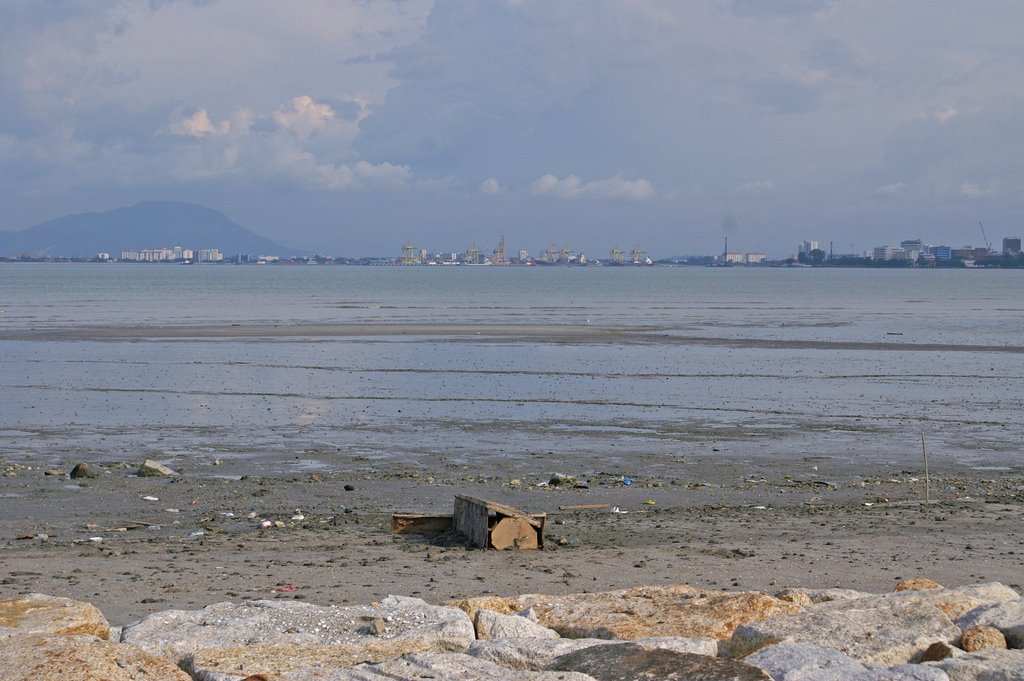
Decided to go back and try to get some more pics of Little Stints today. I wanted to set up a
'coffin'-type hide, but, after scouting around on the beach, couldn't find enough driftwood to put one together. Instead I set up a standing structure as a kind of 'proto-hide' out of whatever I could find, just to get the birds used to the idea of an odd shape out there on the mud. Then I went off for lunch. By the time I came back, birds were happily feeding around the structure, so I replaced it with my hide and the birds soon came back.

With the weather still overcast and quite breezy, it wasn't too hot in there today!One thing I have wanted to try to photograph for a while is the territorial fighting that Lesser Sand Plovers often indulge in on the mud. I got my chance today.

First the two contestants: in the blue corner, this fine adult... And in the red corner, the contender, this rather scruffy 1st winter.
The 1st winter has crossed an invisible line And is put to flight
 It still hasn't backed off far enough for the adult's liking
 The adult brings the bout to an end by giving the vanquished young bird a final earful - "Now clear orf and don't let me see you around here again!"
 This adult Greater Sand Plover strides through the Lesser's territory without molestation.
 Likewise this adult Pacific Golden Plover.
 Even though it is definitely a competitor for the same food the Lesser Sand Plover hunts
 Oddly, this plover didn't have to strain to pull the worm out of its hole as the Lesser Sands always seem to have to. Is it that much stronger, or was it just faster, pulling the prey out before it had chance to anchor itself?
 A Ruddy Turnstone doing what it does best.
 The latest in my series of distant Terek Sandpiper shots. I think this is a juvenile. Incidentally, do you know why a Terek Sandpiper is so named? According to Wikipedia, it's either named after a river in Georgia and Russia or a character in the Flash Gordon TV series.
 It was interesting to note the different species' tolerance of my presence. The sand plovers and stints took it all in their stride. The Terek and Pacific Golden Plover were clearly suspicious, while a Whimbrel which landed fairly distantly took one look and fled, yelping in alarm.
 Don't they grow up quickly? This juvenile Redshank has already begun moulting into 1st winter plumage.
What to do with 500 Red-necked Stint photographs? I suppose I could try auctioning them on E-Bay? My wife and kids' perennial question when I come home from a day like this is, why do you need so many photos of the same bird? Only a photographer would understand! Here's a selection.


Here's a couple playing leapfrog!


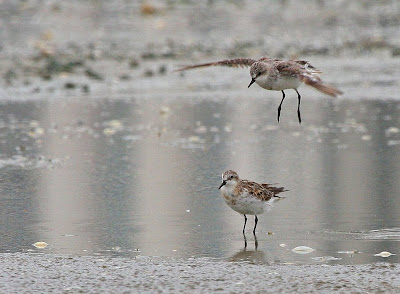
I have a confession! Two days ago I photographed one of the Little Stints from a fair distance. I was sure it was a Little Stint, but when I looked at the photograph after I got home, doubts started to creep in. Was it really a Little Stint? Had I pointed the camera at the wrong bird?
 This is the photo. Surely the sides of the breast are just to red for a Little? And they look unstreaked.
 Fortunately I saw the bird again today, somewhat closer, and it was indeed a Little Stint, albeit a very bright one!
In fact, I photographed 2 different Little Stints today, both different from the ones I put on my blog on 7th, so that makes a minimum of 4 birds.
 Here's a view of the birds' right side. The two birds on the left are those I photographed today; the other two were taken two days ago. The main difference in the two birds today was in the amount of fringing left on the wing coverts, and also in the colour of the crown. The left hand bird had relatively unworn coverts with bright fringes, and a grey crown (moulted), while the second from left had worn, unfringed coverts and a darker, brighter crown. Both birds had already moulted most scapulars and mantle feathers, so were quite similar in overall appearance.
 I didn't get more pics of the non-breeding bird, so only three are shown from the left side. Again, the difference in covert wear is striking between the two left hand birds.
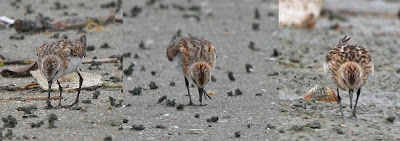 The left hand bird has moulted both crown and mantle, the middle one has moulted mantle but not crown, while the one on the right has moulted neither!
 Though it is usually true that worn breeding Little Stints are yellower than Red-neckeds at the same stage, it isn't always, as these pics show! Structural differences are the key. Of plumage features, the difference in the colour of the greater (and sometimes other) covert fringes is one of the more reliable differences between them.
Of course, if the coverts are as fresh as this, there's no problem! I've heard it said that Little has more of a white flash on the primaries than Red-necked, but haven't seen any photographic evidence to bear this out. I think chestnut fringes to the rump, uppertail coverts and tail feathers may be diagnostic of Little.